
TL;DR: Dry-aged beef is stored in a temperature- and humidity-controlled cool room for 21 to 120+ days. Natural enzymes break down muscle fibres, moisture evaporates to concentrate flavour, and beneficial surface mould contributes complex, nutty notes. The result is the most tender and flavourful beef you can buy — and it costs more because up to 50% of the original weight is lost before it reaches your plate.
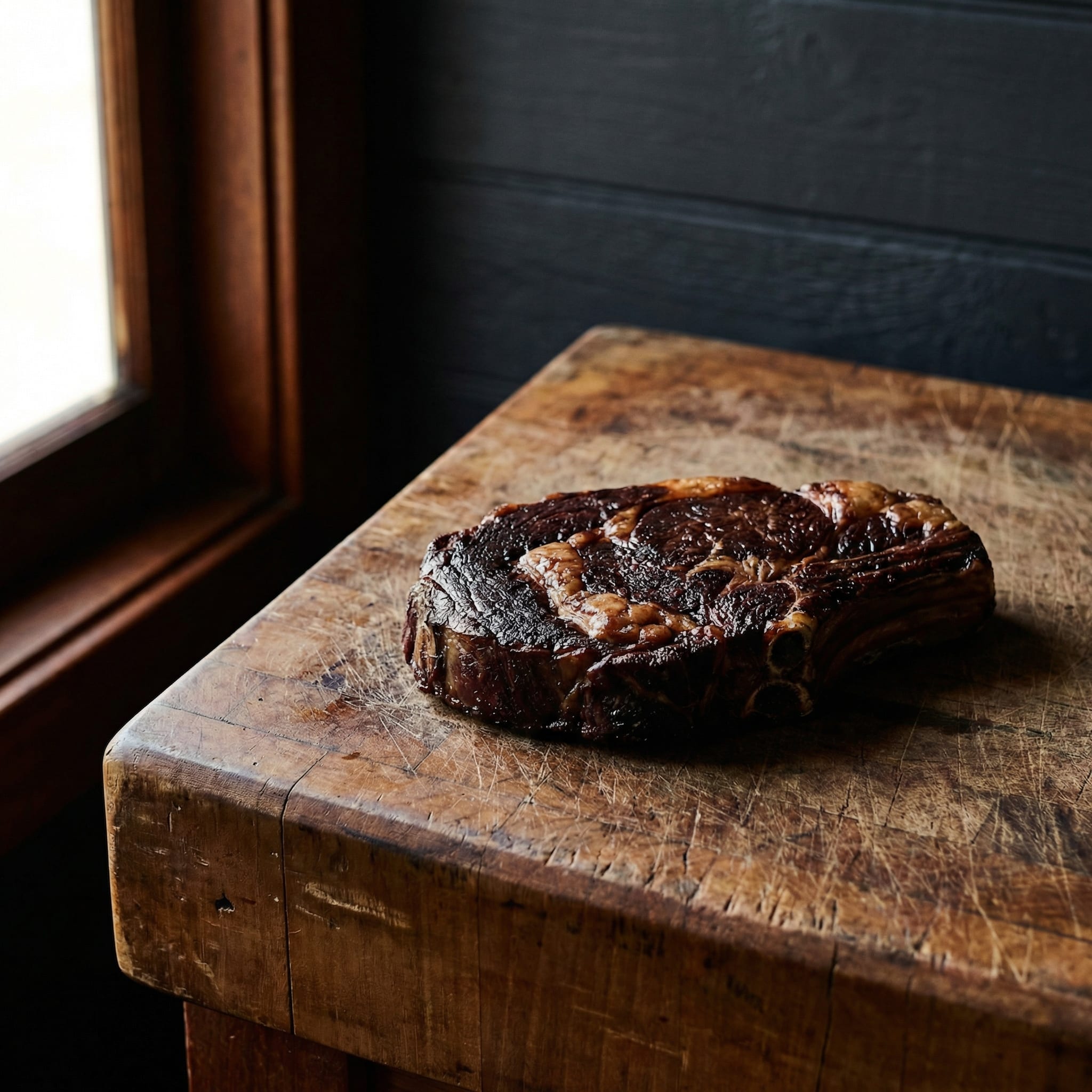
Dry-aged beef is one of those things where a little knowledge makes a meaningful difference — both in choosing the right cut and in getting the most out of it when you cook it. As a butcher who ages beef on the premises every week, we've seen firsthand how much the ageing process transforms a cut. If you've ever wondered why a dry-aged scotch fillet tastes so much richer than a standard steak from the supermarket, or why the price tag is noticeably higher, this guide covers the science, the process, and everything you need to cook it well. If you're ready to explore our range, you can browse our premium beef cuts → but read on first.
Dry ageing is the process of storing whole beef primal cuts in a precisely controlled cool room for a minimum of 21 days — and up to 120 days or more. The environment is maintained at 0.5-3°C, with 75–85% relative humidity and consistent airflow. During that time, three separate processes work together to transform the dry-aged meat: moisture evaporates to concentrate flavour, natural enzymes tenderise the muscle fibres and connective tissue, and controlled surface mould develops complex flavour compounds.
The result is a cut that's noticeably more tender and more deeply flavoured than fresh or wet-aged beef. In practice, the taste is often described as nutty, buttery, or faintly reminiscent of aged cheese — depending on how long it's been aged. Put simply, no other production method delivers the same combination of flavours and tenderness.
Key fact: The ideal dry-ageing environment is 0.5–3°C, 75–85% relative humidity, and 0.2–0.5 m/s airflow. Outside these parameters, the ageing process either stalls or creates unsafe conditions. Source: Ribeiro et al. 2025 (PMC).
🔪 From the butcher: In our experience, dry ageing delivers its best results on large primal cuts — whole ribeye, striploin, or sirloin sections. The surface area of these big pieces forms a natural crust that protects the interior, concentrates flavour, and allows the enzymatic process to work evenly. We've found you simply won't get the same result trying to age individual steaks at home.
Three interconnected changes happen during dry ageing. Understanding them explains both why the flavours are so different from standard beef and why the price reflects the process.
As beef ages in open air, water evaporates from the surface. This isn't spoilage — it's concentration. A 2016 review published in the Journal of Animal Science and Technology (Kim et al.) found that moisture loss follows a predictable curve: approximately 5% at 14 days, 10% at 21 days, and 15% by 30 days. Furthermore, this rises to around 23% at 50 days and 35% at 120 days. When you factor in trimming the dried outer crust before the meat is sold, combined yield losses can reach 50% of the original weight.
As a result, less water means the same beefy flavour compounds packed into a smaller, denser piece of meat — which is exactly what you taste in the pan.
Muscle fibres in beef are held together by proteins. Two groups of naturally occurring enzymes — calpains and cathepsins — begin breaking down these proteins and connective tissues as soon as the animal is processed. Research by Kim et al. (2016) found that calpain activity is highest in the first seven days of ageing. Consequently, the greatest tenderness gains occur by day 14. Moreover, a 2025 global review (Ribeiro et al.) found that proteolysis reduces shear force — the measurable resistance when cutting through meat — by 25–30% over the first 14 to 21 days. Surface mould, in turn, contributes a further 10–15% reduction between days 21 and 35.
The practical result: a 30-day dry-aged steak cuts and chews significantly more easily than the same cut straight off the carcass.
Key fact: Calpain enzymes are most active in the first 7 days of ageing. By day 14, the greatest tenderness gains have already occurred — making even a 2-week aged cut noticeably more tender than fresh. Source: Kim et al. 2016 (PMC).
A powdery, white-grey surface mould develops naturally in the ageing environment. Importantly, this isn't spoilage. Mould species such as Thamnidium elegans produce enzymes that penetrate the outer layers of the meat and contribute flavour compounds deep inside the cut. The surface crust — including the mould — is fully trimmed before the meat is cut and sold. Only the aged interior reaches your plate.
Additionally, as beef ages, its surface water activity drops from around 0.98 to 0.80–0.85 within the first 7–14 days, creating conditions that inhibit pathogenic bacteria while allowing beneficial mould to develop. Consequently, this is the natural food safety mechanism that makes professional dry ageing safe under controlled conditions.
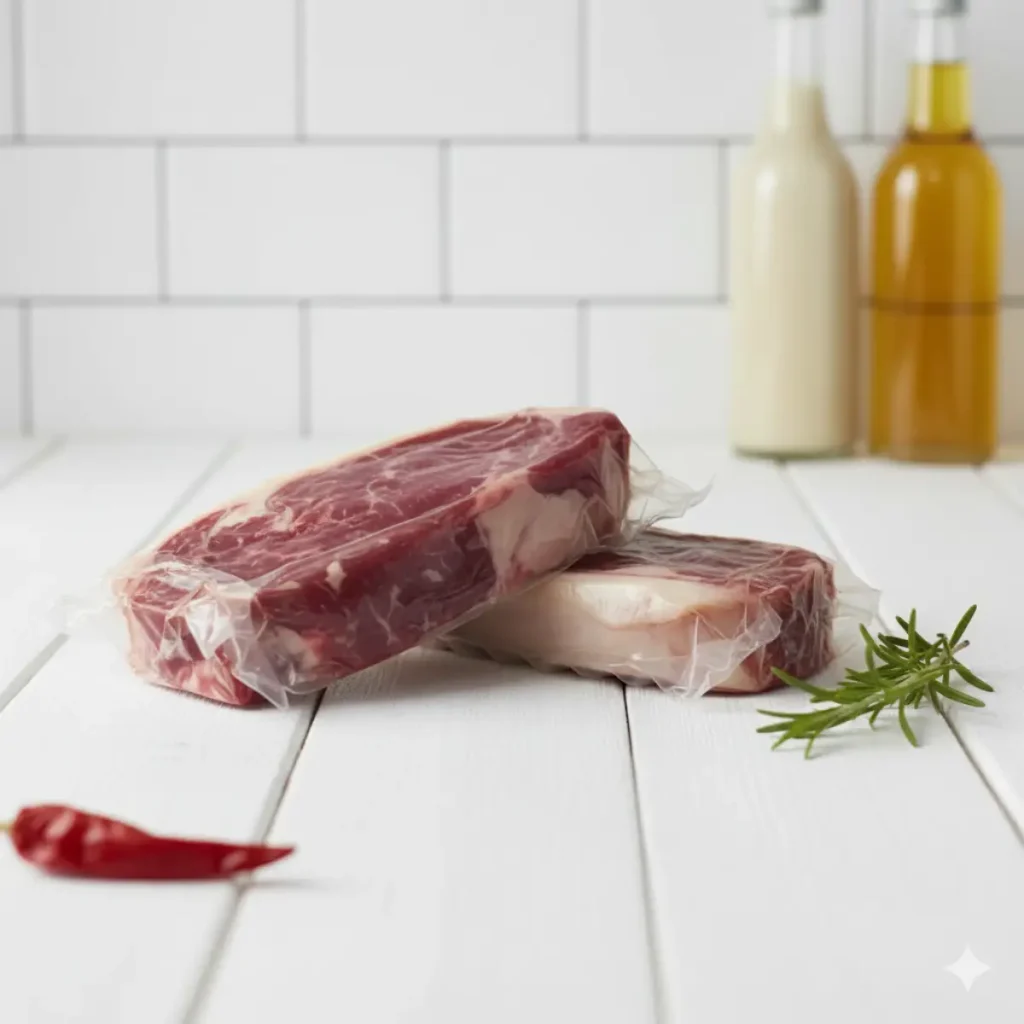
Most beef sold in Australian supermarkets and at many butchers is wet-aged — stored in a sealed, vacuum-sealed bag for 7 to 28 days after processing. Both methods use the same enzymatic tenderising process. However, only dry ageing delivers the flavour concentration and mould-derived complexity that defines premium aged beef.
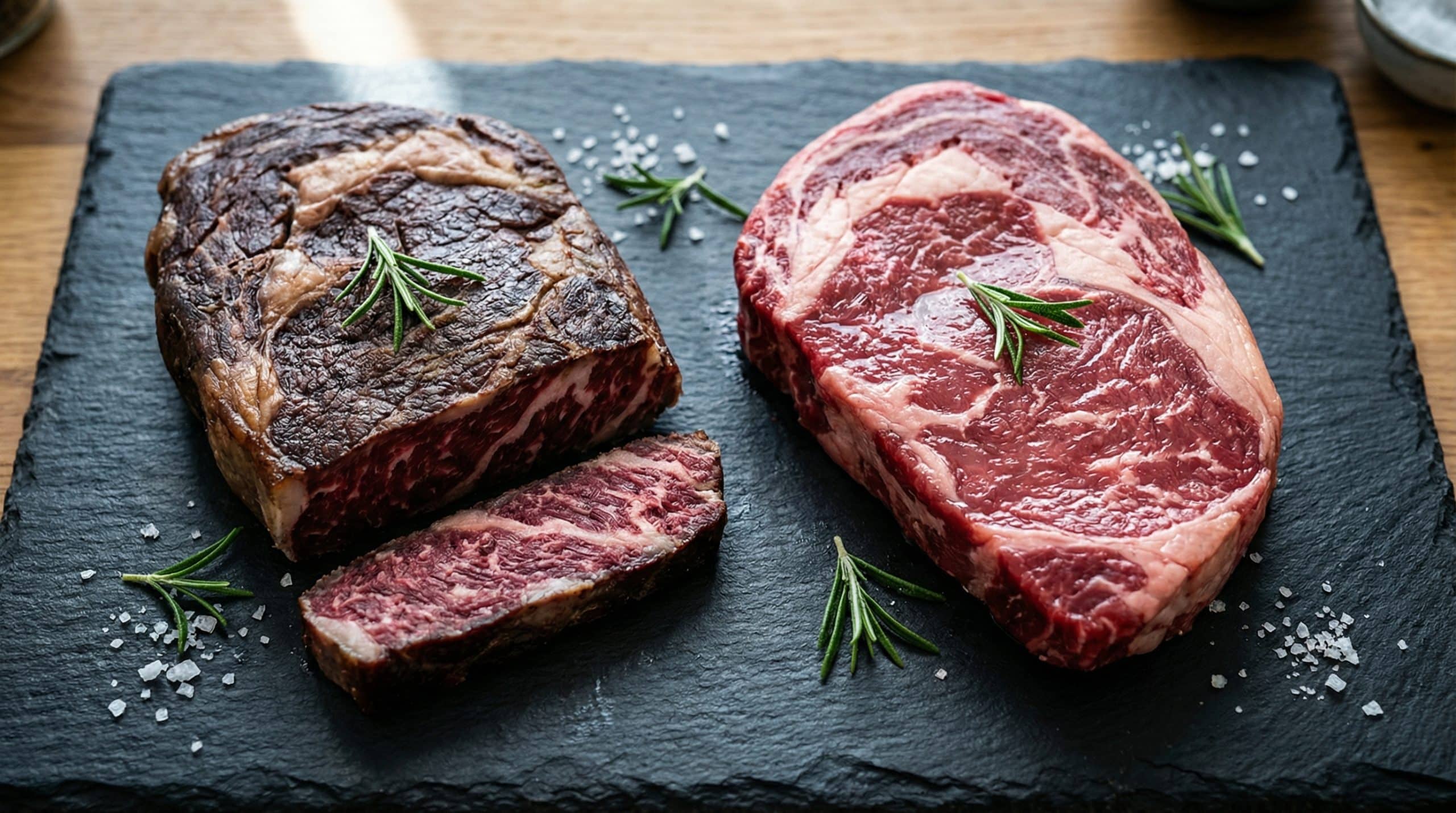
| Dry-Aged | Wet-Aged | |
|---|---|---|
| Flavour | Concentrated, nutty, complex | Clean, mild, mild metallic undertones |
| Tenderness | High — enzymatic + evaporative | Moderate — enzymatic only |
| Moisture | Lower — concentrated | Higher — retained in vacuum bag |
| Colour | Deep mahogany to near-black crust | Bright red to purple-red |
| Ageing window | 21–120+ days | 7–28 days |
| Yield loss | 20–50% | Minimal |
| Price premium | 20–50% above standard cuts | Minimal above standard |
Both methods are legitimate. Wet-aged beef is entirely appropriate for everyday cooking. That said, if you want to cook a steak that genuinely stands out — for a special occasion or simply because quality matters — dry-aged is in a different league.
Not all dry-aged beef tastes the same. Specifically, the ageing window significantly shapes the character of what's in the pan:
💡 Food science: The "blue cheese" character that develops after 45 days comes from short-chain fatty acids — particularly butyric and caproic acid — released as fats break down during extended ageing. These are the same fatty acids responsible for the flavour of aged dairy. It's not a coincidence that very long-aged beef and strong cheese share similar flavour notes.
The price premium on dry-aged beef is genuine and unavoidable. Several factors stack up before a dry-aged steak reaches you:
Yield loss is significant. Moisture evaporation alone accounts for roughly 15% of the original weight by 30 days. Add the trimming of the outer crust — which cannot be sold — and combined losses can reach 50% of the purchased weight. In other words, you're paying for the meat that isn't there because the butcher bought and stored the whole primal cut.
Time and infrastructure are real costs. Furthermore, a dedicated ageing room must maintain precise temperature (0.5–3°C), humidity (75–85%), and airflow (0.2–0.5 m/s) continuously for weeks or months. That means specialised refrigeration, consistent energy use, and skilled day-to-day management.
Risk is higher. Finally, any equipment failure, contamination event, or quality issue during ageing destroys the product that has already been stored for weeks. As a result, dry-aged beef carries an inherently higher risk than turning over fresh cuts quickly.
Overall, Meat & Livestock Australia's research supports a 20% minimum price premium for dry-aged beef over wet-aged equivalents. Furthermore, premium and extended-age products can command 50% above standard pricing. For most home cooks, therefore, 28–35 day aged beef represents the best value within the dry-aged category — maximum flavour return before the yield losses of longer programs significantly push up cost.
Shop our dry-aged range: 30-day dry-aged scotch fillet — aged in-house, cut to order, and delivered across Sydney and regional NSW.
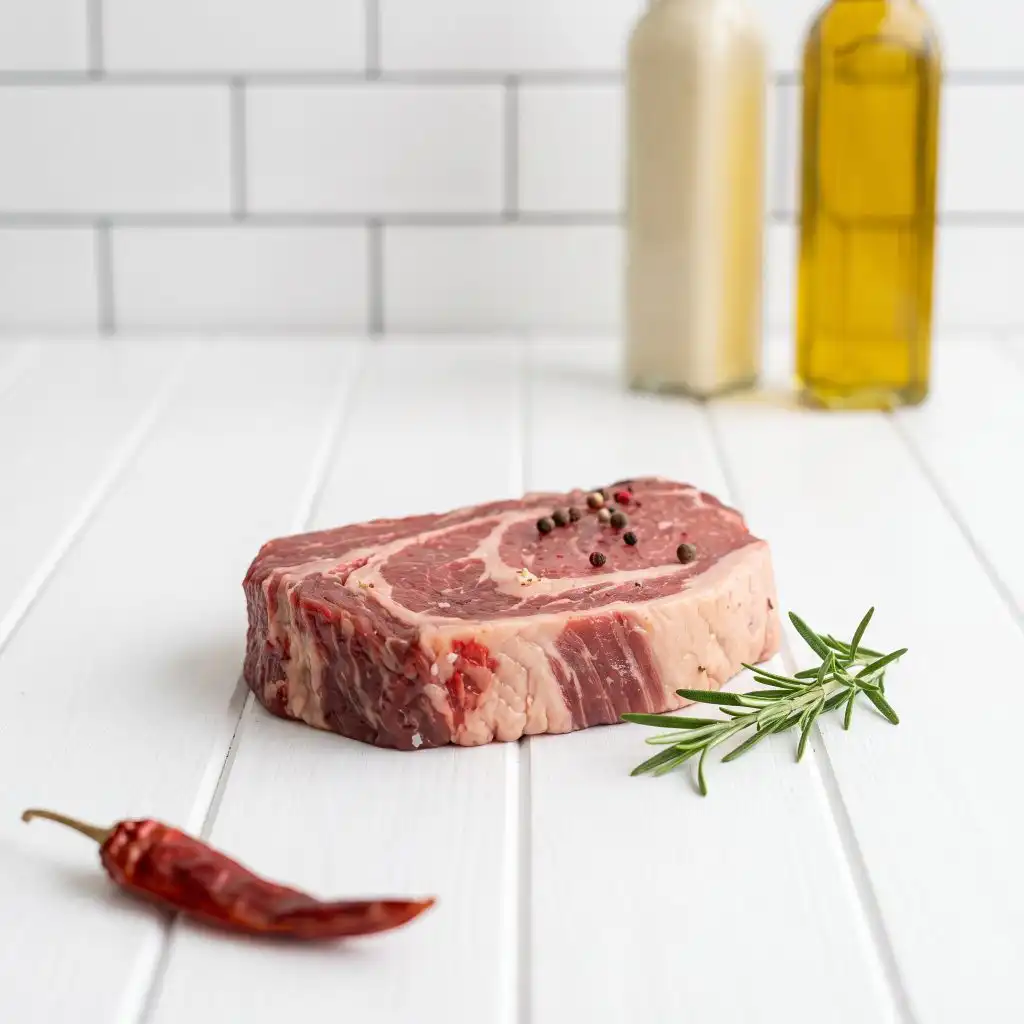

Dry-aged beef rewards simple cooking above all else. The flavour is already there — your job is to bring it out without masking it.

First, take the steak out of the fridge 30–45 minutes before cooking. Cold meat straight from the fridge hits the pan unevenly, resulting in an overcooked exterior before the centre reaches temperature. Then season generously with coarse salt and freshly cracked black pepper — nothing more. Dry-aged beef doesn't need marinades; in fact, a heavy marinade will bury the complex flavours you've paid for.
Use a cast-iron pan or a heavy-based stainless steel pan over high heat. Add a neutral oil with a high smoke point — not olive oil. When the pan is properly hot, place the steak in it and leave it alone. A crust forms through the Maillard reaction — the same browning process that develops flavour in roasted coffee, bread crust, and seared meat. Flip once. Then, in the last 90 seconds, add a knob of butter and fresh thyme or rosemary and baste continuously.
Target internal temperatures:
A quality digital thermometer is worth the investment when you're cooking dry-aged beef.
Rest the steak 5–10 minutes, loosely tented with foil. Cutting immediately causes juices to run — resting lets them redistribute through the muscle. With dry-aged beef, which already has lower moisture than standard cuts, this step matters more. Therefore, don't skip it.
🔪 From the butcher: Don't overcook dry-aged beef. In our experience, at medium-well or well-done, you lose the remaining moisture and most of the layered flavours you paid for. Medium-rare is the sweet spot — and we'd recommend it strongly. If you're not yet comfortable hitting temperature consistently, a digital thermometer will genuinely change how you cook steak. It removes all the guesswork.
Storage matters once you have dry-aged beef at home. Specifically:
Yes. Professional dry ageing is conducted under strict food safety controls. In Australia, specifically, dry-aged meat production is governed by FSANZ Standards 3.2.2 and 3.2.3, which set requirements for temperature, hygiene, and processing environments. The surface crust — including any mould — is fully trimmed before sale. As a result, what you receive is the safe, aged interior.
At 21–30 days, expect deep, concentrated beef flavour with a pronounced nutty, buttery quality and strong umami. Beyond 45 days, however, more complex and funky notes develop — described by many as reminiscent of blue cheese or aged dairy. Overall, the flavour is more intense than standard beef but not gamey.
Wet-aged beef is stored vacuum-sealed, which allows tenderising but retains all moisture and prevents the mould-driven flavour development of dry ageing. Consequently, wet-aged beef has a cleaner, milder flavour with no yield loss. By contrast, dry-aged beef is more expensive, more complex in flavour, and noticeably more tender.
The industry standard is 21–28 days, which delivers peak umami and significant tenderising. Sensory improvements largely plateau around 35 days. Therefore, ageing beyond that is about pursuing an intensifying, specific flavour character rather than a simple quality upgrade. For most home cooks, 28–35 day aged beef is the ideal window.
It's technically possible but genuinely difficult to do safely. Professional ageing requires precise temperature control (0.5–3°C), consistent humidity, and managed airflow. A standard household fridge, however, is too humid and lacks proper air circulation. Dedicated home dry-ageing units are available but expensive. For most people, therefore, buying professionally aged beef from a trusted butcher is safer, more reliable, and often better value.
Yes — vacuum-seal and freeze at −18°C for 6–12 months with minimal quality loss. Simply thaw overnight in the fridge.
If you're looking for a starting point, our 30-day dry-aged scotch fillet is cut and packed to order. You might also enjoy checking INTERNAL-LINK: our full range of beef cuts to find what suits your next cook.
