
Osso bucco turns tender for one specific reason: collagen inside the shank begins converting to gelatin at around 50°C (122°F), and that conversion speeds up sharply between 71-82°C (160-180°F) (America's Test Kitchen, 2022). Cook it hot and fast and that collagen never gets the time it needs, so you end up with meat that's chewy no matter how long it sat in the pan. Most home cooks either rush the braise or don't know what to actually ask their butcher for when they get to the counter.
This guide fixes both problems. You'll get real cut-selection guidance (thickness, bone-in, which shank) and a genuine method with actual oven, stovetop and slow cooker temperatures, not a vague instruction to "braise until tender." It's written by the team at Pryde Butchery, from behind the counter, not a recipe blog, because the biggest gap in most osso bucco content isn't the cooking. It's not knowing what you're buying in the first place. Questions about a specific cut? Get in touch, that's what the counter is for.
Cuts like this are also having a moment. Meat & Livestock Australia's 2026 trends report names whole-carcase utilisation and "slow craft" technique among six defining shifts in how Australians are cooking red meat this year (MLA, 2026). Osso bucco fits both trends exactly: a whole-carcase cut, cooked the slow way, on purpose. Shop osso bucco to get started.
Osso bucco is a cross-cut veal or beef shank, bone-in, with marrow at the centre. Collagen starts converting to gelatin around 50°C, accelerating between 71-82°C (America's Test Kitchen, 2022). Braise 2.5-3 hours, oven, stovetop or slow cooker, until a fork meets the meat with slight resistance.
Osso bucco is a cross-cut veal or beef shank, sliced through the bone so each piece keeps a ring of marrow at its centre. The name is Milanese dialect for "bone with a hole." A 100g serving of braised veal osso buco carries 29.12g of protein (USDA FoodData Central, FDC ID 172646), which is the kind of density you'd expect from a cut this hardworking.
The cut comes from the shank, the leg muscle just above the hoof. Because that muscle is in constant use, it's dense with connective tissue, exactly the collagen that makes slow cooking non-negotiable here. Butchers cross-cut it into rounds roughly 2.5-4cm thick, bone and marrow intact.
Why does the bone matter as much as the meat? Because the marrow renders during a long braise and bastes the meat from the inside, adding real richness to the sauce rather than sitting there as a garnish. Trimming it out, which some home cooks ask for out of habit, throws away most of what makes this cut worth cooking in the first place.
Veal osso buco is the classic Milanese version and the more tender of the two, since younger animals carry less toughened connective tissue. Beef osso bucco, usually cut from the same shank position on a mature animal, has a deeper, beefier flavour and generally wants a slightly longer braise to get there.
Gravy beef and beef shin come from the same shank region and share the same collagen-rich structure, but they're sold boneless and pre-diced rather than cross-cut. That makes them a genuine stand-in when osso bucco isn't available, though you lose the marrow and the presentation that make this cut distinctive on the plate.
The short answer: ask for a 2.5-4cm thick cross-cut, bone-in, from the hind shank if your butcher offers a choice. Thickness controls how evenly the piece braises; anything thinner tends to dry out before the collagen has fully converted, no matter how careful you are with the liquid.
Hind shank carries slightly more meat relative to bone than fore shank, so it's the better pick if you're feeding a crowd and want more per portion. Either works fine for flavour; the real difference is yield, not taste. As a rough buying guide, one cross-cut shank per person is standard restaurant portioning, so plan on four shanks for a table of four.
Marrow colour is a genuine freshness signal, not just aesthetics. It should read as a rosy pink to deep red, sitting snugly against the bone wall. If it looks dull, grey, or has pulled away from the bone, ask your butcher for a fresher cut rather than assuming it's fine.
What if osso bucco isn't in the cabinet that week, or the price has crept up? Gravy beef and beef shin braise the same way and typically cost less, though you'll be building flavour without the marrow, so lean a little harder on the aromatics and stock. Both come from the same slow-cooking end of the carcass; see our complete guide to Australian beef cuts for where they sit alongside osso bucco.
By the end of this section you'll have an exact method: brown it, build the braising liquid, then go low-and-slow until a fork meets the meat with slight resistance, not until it shreds apart. Everything below uses real temperatures and real time ranges, not "cook until tender."
Pat the shanks completely dry before they touch the pan; wet meat steams instead of browning. A light dust of flour adds a touch of body to the sauce later, though it's entirely optional. Sear in a heavy pot over medium-high heat, 3-4 minutes per side, until each face has a deep brown crust. Don't crowd the pot, work in batches if you need to. That crust carries most of the flavour in the finished dish, so it's worth not rushing.
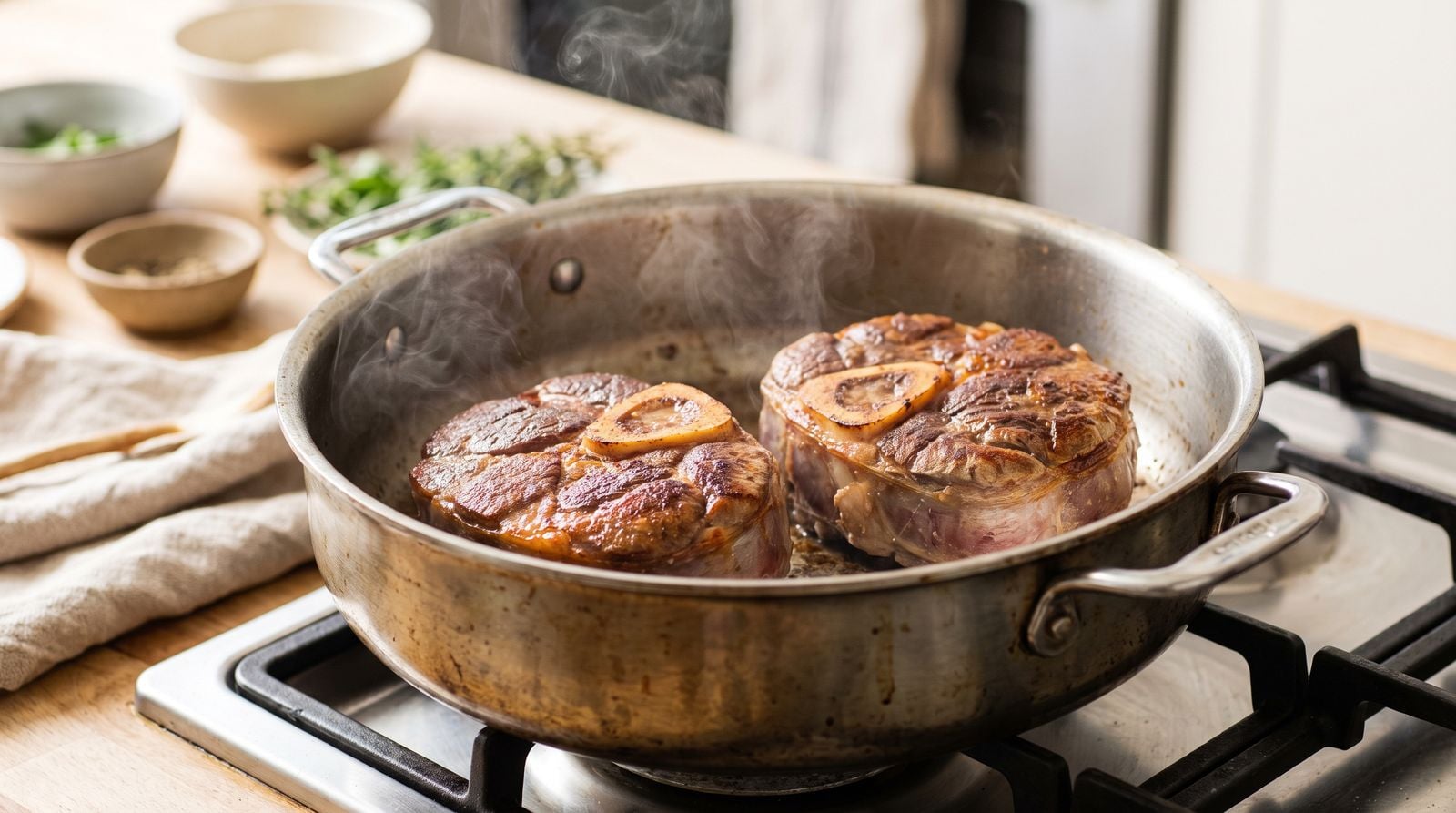
Remove the shanks and soften a classic sofrito, diced onion, carrot and celery, in the same pot for 5-7 minutes. Deglaze with a generous splash of dry white wine, scraping up the browned bits stuck to the base; that's flavour you don't want to leave behind. Return the shanks to the pot and add stock until it reaches roughly two-thirds up the sides. Don't fully submerge them.
Tomato is genuinely a matter of taste here. A modern osso bucco leans on tomato paste or crushed tomatoes for body and colour. Osso bucco in bianco is the traditional Milanese version, which skips tomato entirely and stays paler and brighter, closer to the original 19th-century dish.
Cover and braise at 160°C (140°C fan) for 2.5-3 hours. Check the liquid level once an hour and top up with stock if it's dropped below halfway. You'll know it's close when the meat starts pulling slightly away from the bone; that's your cue to switch from watching the clock to checking with a fork.
Bring to a bare simmer, then drop to low with the lid ajar. It needs closer attention than the oven, since stovetop heat is less even and the liquid can reduce faster than expected. Budget the same 2.5-3 hours and check every 30-40 minutes.
On low, osso bucco needs 7-8 hours to reach the same result, which makes it the easiest hands-off option if you're out for the day. Brown the shanks first regardless; skipping that step trades real flavour for convenience you don't actually need.
Quick reference: which method suits your day
| Method | Setting | Time | Best for |
|---|---|---|---|
| Oven | 160°C (140°C fan) | 2.5-3 hours | Most even result, minimal attention |
| Stovetop | Low simmer, lid ajar | 2.5-3 hours | No oven access, don't mind checking in |
| Slow cooker | Low | 7-8 hours | Out of the house all day |
All three methods are aiming at the same internal target, just on different clocks. Collagen starts converting to gelatin around 50°C (122°F, America's Test Kitchen, 2022), but conversion only really accelerates between 71-82°C (160-180°F), which is why a quick sear-and-serve approach never gets there. Held in that zone for hours, tough connective tissue turns silky; rushed, it just stays tough.
Food safety still applies on a low-and-slow braise, even though it doesn't feel like the kind of cooking where it comes up. Australian guidance sets a minimum safe internal temperature of 70°C at the centre for standard cuts, and 75°C for minced or rolled products (FSANZ, 2025). Every method above clears that minimum well before the collagen has fully converted, so doneness, not safety, ends up being what actually decides your final cook time.
How do you know it's actually done, rather than just soft? The meat should yield to a fork with slight resistance and ease cleanly away from the bone. It shouldn't fall apart into shreds; that's overcooked for this cut, and it loses the texture that makes osso bucco worth the wait in the first place.
If you're cooking ahead, cool leftovers quickly rather than leaving the pot on the bench. Safe practice is cooling from 60°C to 21°C within two hours, then 21°C down to 5°C within a further four hours, and reheating rapidly back above 60°C before serving again (FSANZ, 2025).
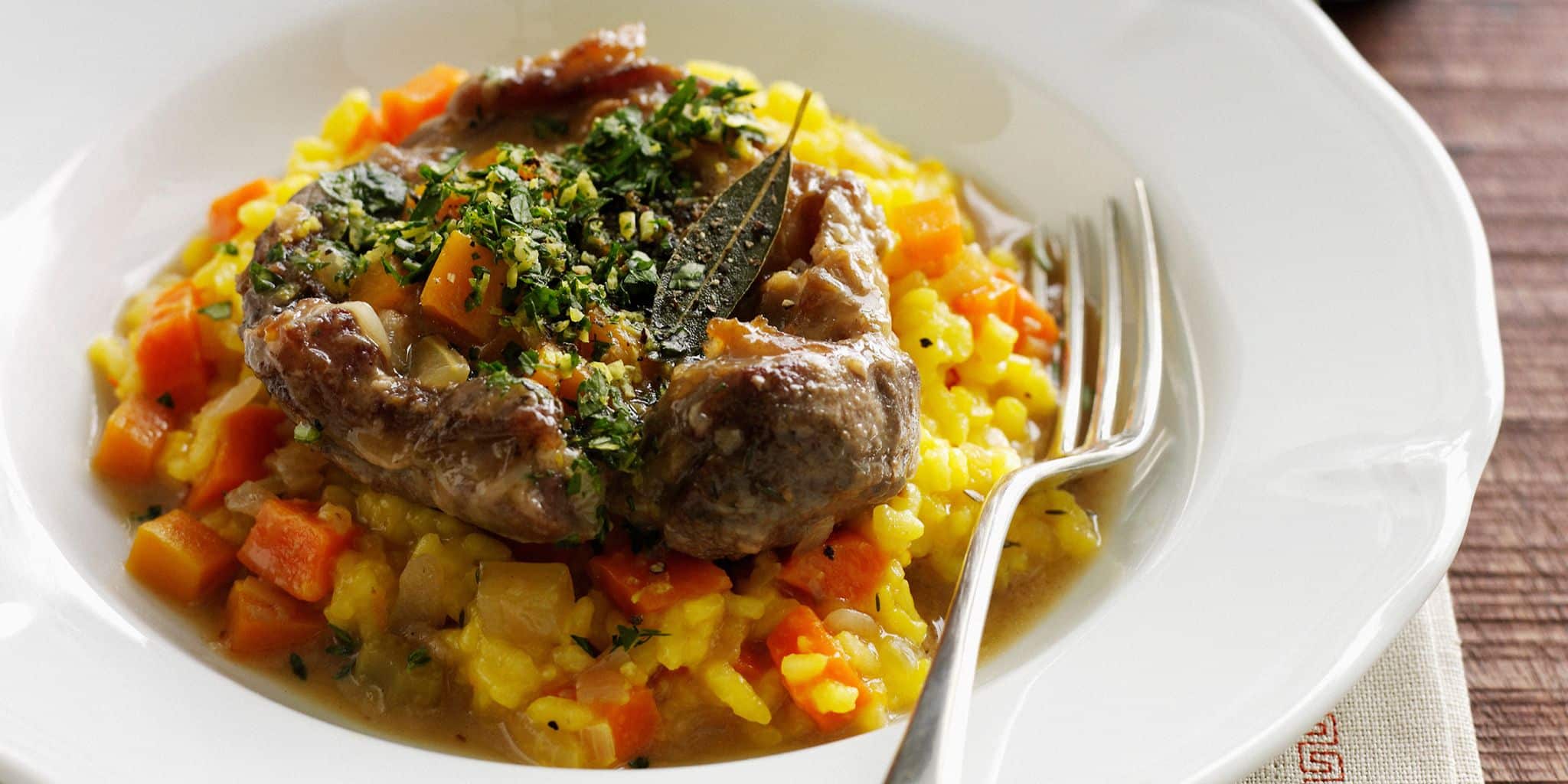
Osso bucco practically demands a starch that can soak up the braising liquid: risotto alla Milanese, soft polenta, or mashed potato all do the job, and the choice mostly comes down to how rich you want the whole plate to feel.
Risotto alla Milanese, coloured and flavoured with saffron, is the traditional Lombard pairing and the one you'll see served alongside osso bucco most often in Italy. Soft polenta is a lighter, quicker alternative that catches the sauce just as well. Mashed potato works too, and it's the version most home cooks already know how to make well.
Gremolata is a raw lemon, garlic and parsley mix that finishes the dish rather than just garnishing it. It takes minutes:
The raw garlic and citrus cut through the richness of the braise in a way nothing else on the plate does.
Do you need all three sides on the table at once? Not really. One starch plus the gremolata is plenty, since osso bucco is rich enough that a simple green salad rounds out the plate without any extra cooking.
Structured, tannic reds work with osso bucco for a specific chemical reason, not just tradition. Tannins and polyphenols bind to lipid droplets in fatty, rich food, which lowers how astringent the wine tastes and lets its fruit come through (UC Davis Waterhouse Lab, n.d.). That's the actual mechanism behind the classic pairing, not just a rule of thumb.
Barolo and Barbaresco, both built from Nebbiolo, carry exactly this kind of firm tannic structure, which is why they're the traditional match in Piedmont. Chianti Classico and other Sangiovese-based reds offer a lighter, more acid-driven version of the same effect, and they're a more affordable entry point if Barolo's out of budget this week.
Does the science actually matter, or is "red wine with red meat" close enough? Yes, but the reasoning is worth knowing: it explains why a soft, low-tannin red can taste thin next to this dish, while a genuinely structured one holds its own against the richness.
If you've made the paler "in bianco" version without tomato, a crisp white with some texture, Gavi or Vermentino, suits it better than a red would. That lighter braise doesn't carry enough fat to need tannin cutting through it the same way.
What is osso bucco made from?
Osso bucco is a cross-cut section of veal or beef shank, sliced through the bone so each piece keeps its ring of marrow. It's not a specific breed or dish name, it's a butchery cut: the term describes how the shank is prepared, cross-cut rather than left whole like a lamb shank.
Why is my osso bucco tough?
Almost always, it hasn't spent enough time in the collagen-conversion zone. Conversion accelerates between 71-82°C (160-180°F) (America's Test Kitchen, 2022), and cutting the braise short leaves connective tissue intact and chewy. Give it the full 2.5-3 hours and check with a fork before pulling it off the heat.
Can I make osso bucco in a slow cooker?
Yes. Brown the shanks first for flavour, then transfer everything to the slow cooker on low for 7-8 hours. It takes longer than the oven or stovetop, but it's genuinely hands-off, which makes it a solid option if you're out of the house all day.
What's the difference between osso bucco and beef shin?
Beef shin comes from the same shank region but is typically sold boneless and diced rather than cross-cut with the bone and marrow intact. Both braise the same way and suit the same cooking times, so shin is a reasonable substitute; you'll just lose the marrow and the presentation.
What wine goes with osso bucco?
A structured, tannic red, Barolo, Barbaresco or Chianti Classico, is the classic match, since tannins bind fat and cut richness (UC Davis Waterhouse Lab). For the paler "in bianco" version without tomato, a textured white like Gavi or Vermentino suits the lighter braise better.
You now have what a vague recipe never gives you: real temperatures, real times, and genuine cut-selection advice from behind the counter, not just Italian-cuisine trivia. Osso bucco rewards patience more than skill. Get the collagen conversion right and the rest mostly takes care of itself.
Ask your butcher for a 2.5-4cm cross-cut, bone-in, and don't let anyone talk you into trimming the marrow. Then give it the full braise, oven, stovetop or slow cooker, and check doneness with a fork rather than the clock.
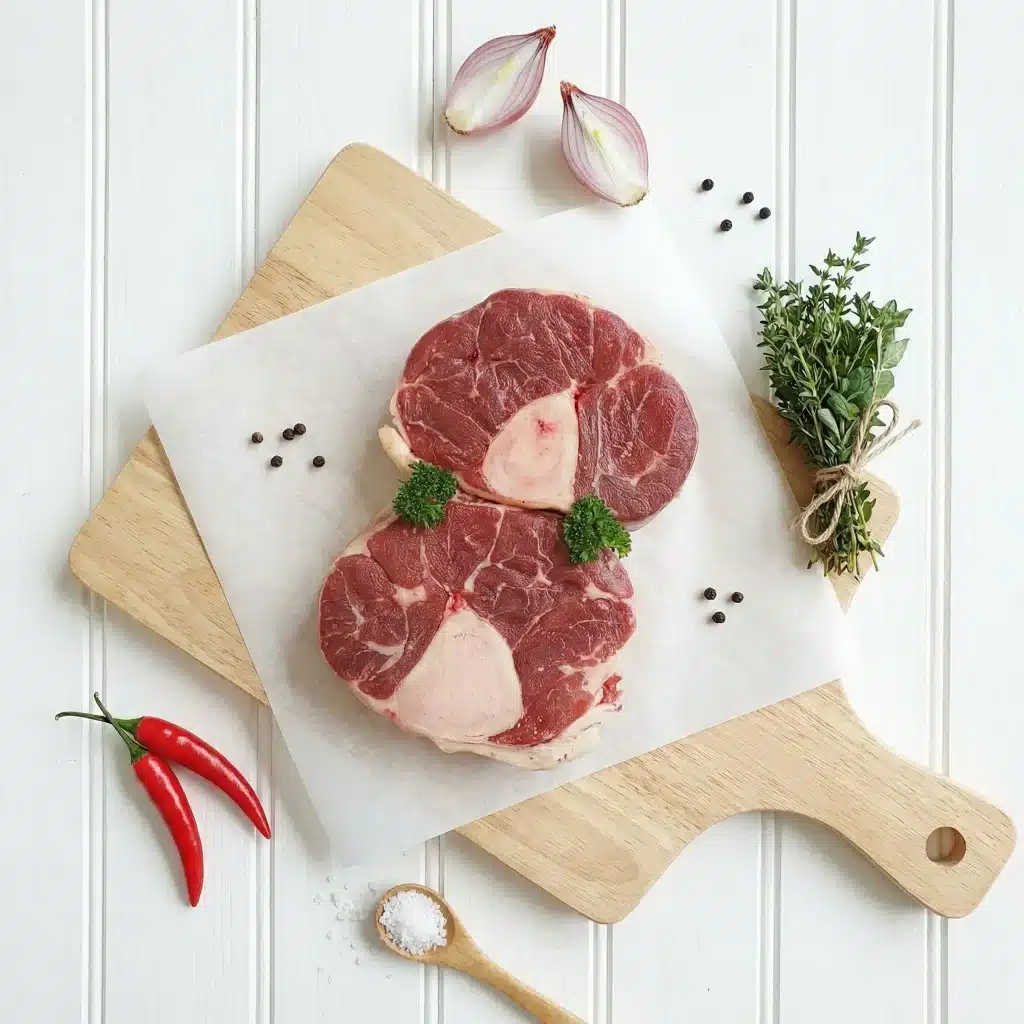
Beef Osso Bucco is a cross-cut section from the beef shin, featuring a centre bone with rich marrow surrounded by flavourful, collagen-rich meat. Perfect for slow cooking and braising, this cut transforms into melt-in-your-mouth tenderness with a deeply satisfying, gelatinous texture. Ideal for hearty winter meals, classic Italian braises, and comforting stews that bring restaurant-quality results to your table.
One steak is approx 380 grams
Looking for other slow-cooking cuts? See our complete guide to Australian beef cuts for where they sit on the carcass.
