

TL;DR: Australian beef is divided into 8 primal cuts, each yielding distinct sub-primals and retail cuts with names that differ from the US and UK systems. Knowing which primal your steak comes from tells you how to cook it. This guide maps every major Australian cut back to its source — primal, location, and cooking method.
When I first started operating a butcher's shop, I discovered that while I was relatively familiar with the various cuts of meat and how to prepare them, there was, in fact, another whole language of meat to learn—the primal cuts.
While not absolutely necessary for the everyday home cook, it can be useful to know where the various cuts come from, particularly if you want to start experimenting with different recipes. It also helps when you're trying to adapt a recipe from another country, and the cut names don't match. And if you're really stuck, you can print out the chart and take it to your butcher—they'll certainly know from that what you're after!
92% of Australian households purchase beef every week (Meat & Livestock Australia, 2025), yet most of us choose cuts by name recognition alone. An Australian beef carcass is split into 8 primals—large sections butchered from the whole before being broken into the retail cuts sold at the counter. Every cut you buy traces back to one of these 8 zones.
The carcass divides into two main sections: the forequarter (shoulder, neck, ribs, brisket, flank) and the hindquarter (loin, rump, leg). These then break into the 8 primals, each with its own MSA (Meat Standards Australia) sub-primal codes and retail cuts.
Australia's beef cutting system is set by the Meat Standards Australia program and documented in the MLA Handbook of Australian Meat. It differs slightly from the US system (which uses 9 primals) and the UK system, which is why steak names change the moment you cross borders.

| Primal | Location | Key Retail Cuts | Cooking Method | Tenderness |
|---|---|---|---|---|
| Chuck + Blade | Shoulder & neck | Chuck roll, oyster blade, bolar blade, chuck tender | Braise, slow cook | Low |
| Rib (Cube Roll) | Mid-back, ribs 7–12 | Scotch fillet, rib eye, tomahawk | Grill, pan-fry, roast | High |
| Loin | Lower back | Eye fillet, porterhouse, T-bone | Grill, pan-fry | Very high |
| Rump | Upper hindquarter | Rump steak, rump cap, eye of rump, tri-tip | Grill, roast, BBQ | Medium |
| Topside | Inner hind leg | Topside, eye of topside | Slow roast, braise | Low–Med |
| Knuckle + Silverside | Outer hind leg | Knuckle, outside flat, eye round | Slow roast, stir-fry thin | Low |
| Brisket | Chest | Brisket point end, brisket navel end | BBQ, slow cook, braise | Low |
| Flank + Shin | Belly & lower leg | Flank steak, osso buco | Marinate + grill; slow cook | Low |
The chuck and blade are the hardest-working muscle groups on the animal—and that's exactly why they produce the most flavourful slow-cooked dishes. Located in the shoulder and neck, these cuts are high in collagen, which converts to gelatin during long, slow cooking, creating the rich, sticky texture in braises and stews. The Australian butcher's shop uses MSA codes to distinguish between Chuck (2261) cuts and the separate Blade group (Oyster Blade 2303, Bolar Blade 2302, and Chuck Tender 2310).
What comes from the Chuck:
What comes from the Blade:
How to cook Chuck and Blade cuts:
For a full breakdown of chuck-derived steaks, including the Denver and flat iron, see our Global Guide to Beef Cuts.
The rib primal—called the Cube Roll in Australian wholesale terminology—runs along the mid-back between ribs 7 and 12. It's the source of the scotch fillet, Australia's most popular premium steak, as well as the tomahawk and standing rib roast. Because this muscle does minimal work, the meat stays tender and develops excellent marbling. The MSA identifies five distinct sub-primals within the Cube Roll group.

What comes from the Rib:
Scotch Fillet and Ribeye—The Naming Flip:
Australia inverts the US convention: in Australia, "scotch fillet" (from Cube Roll 2243) is the boneless steak; "ribeye" refers to the bone-in version. In the US, "ribeye" is the standard boneless steak. The tomahawk is simply a long-bone scotch fillet, French-trimmed, with 30–45cm of bone.
How to cook Rib cuts:
For detailed recipes and regional naming breakdown, see our Global Guide to Beef Cuts.
The loin primal contains the two most prized muscles on the animal: the striploin (porterhouse / New York steak) and the eye fillet (tenderloin). Located in the lower back, these muscles do almost no work—the result is the most tender beef available. The eye fillet in particular has the least connective tissue of any cut. The MSA identifies three sub-primals: Striploin 2143, Short Loin 1552, and Tenderloin 2150.
What comes from the Loin:
The Porterhouse / New York Naming Problem:
In Australia, the striploin steak is sold as either porterhouse or New York steak—both names refer to the same cut (Striploin 2143). In the US, "New York strip" is the standard name; "porterhouse" means something different entirely (a large T-bone with a bigger tenderloin section). Australian T-bone = US Porterhouse. This is one of the most confusing cross-regional naming differences in beef. For a full breakdown of how these names differ around the world, see our Global Guide to Beef Cuts.
How to cook Loin cuts:
All loin cuts are best served medium-rare or medium. Never cook above 60°C—the low fat content means overcooking renders the meat dry.
The rump primal is one of Australia's most versatile and underrated. It's a five-muscle primal sitting above the round and behind the loin—each of those muscles has a different texture, grain, and ideal cooking method. The MSA system identifies 7 distinct sub-primals within the rump, more than any other primal, reflecting how much variety comes from this one section of the hindquarter.

What comes from the Rump (MSA sub-primals):
How to cook Rump cuts:
The hind leg produces Australia's leanest beef cuts across three distinct MSA groups: Topside, Knuckle, and Silverside (Outside Flat). Because these muscles carry the animal's weight every day, they have minimal fat—ideal for slow roasting, corned beef, and stir-fry, but unsuitable for high-heat grilling without preparation. Total of 10 distinct sub-primals across these three sections.
Topside — The Inner Thigh:
The Topside group includes Topside 2000, Topside Cap Off 2001, Topside Cap 2012, and Eye of Topside 2013. Topside is the main inner thigh muscle; lean, tight-grained; the classic slow-roast joint. Cook at 160°C oven with liquid, internal 70–75°C; rest 15 min minimum. The Eye of Topside suits low-temp roast (150°C), internal 65–70°C.
Knuckle — The Stifle Area:
The Knuckle group includes Knuckle 2070, Knuckle Cover 2068, Knuckle Undercut 2069, and Eye of Knuckle 2067. The knuckle is the ball-shaped muscle group from the stifle joint; versatile, lean. Knuckle Cover suits slow roasting or thin-sliced stir-fry. Eye of Knuckle is the leanest portion; roast or use for schnitzel.
Silverside / Outside Flat — The Outer Hind Leg:
The Silverside group includes Outside Flat 2050 and Eye Round 2040. Outside Flat is the main silverside muscle; the classic corned beef cut. Eye Round is a lean, cylindrical muscle; football-shaped; suits slow roasting whole or thin-sliced cold.
Corned Beef = Cured Outside Flat (Silverside):
When Australians say "corned beef," they almost always mean cured silverside (Outside Flat 2050), not brisket as in the US tradition. The brine cure breaks down the tough fibres, making the otherwise very lean muscle tender and sliceable.
How to cook Hind Leg cuts:
Brisket sits on the animal's chest and supports roughly 60% of its body weight, making it one of the toughest cuts. It's also the most rewarding when cooked correctly. Twelve-plus hours of low heat converts the dense collagen into gelatin, producing the juicy, bark-crusted brisket central to Texas-style BBQ. The MSA identifies three distinct sections.
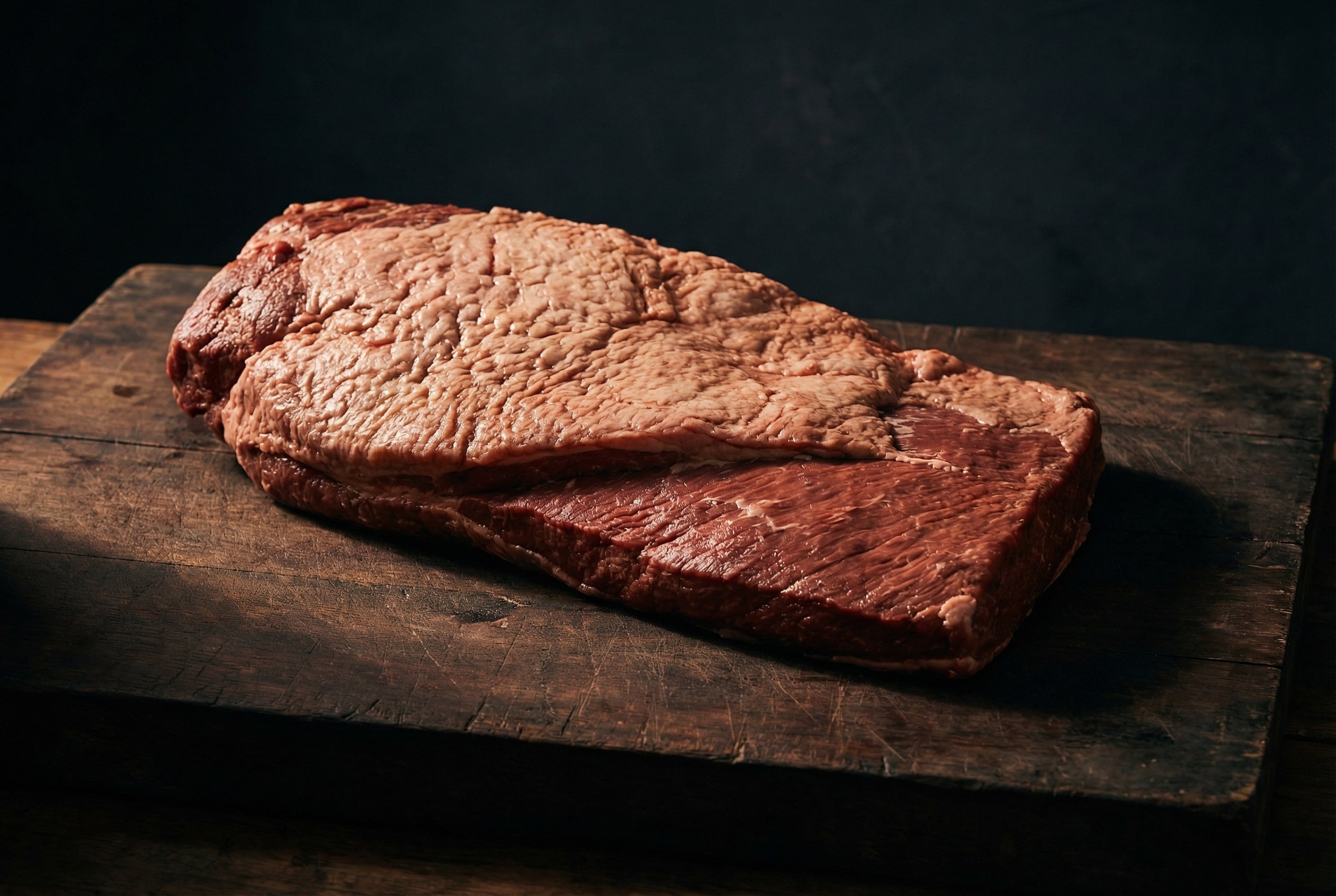
What comes from the Brisket (MSA sub-primals):
A whole packer brisket has both Point End and Navel End intact, connected by a fat seam—used in competition BBQ and increasingly available from Australian online butchers like Pryde.
How to cook Brisket:
Australia exported record beef volumes in 2025—brisket and secondary cuts have driven growth in the US foodservice channel (Meat & Livestock Australia, January 2026). Australian beef brisket is increasingly sought after for BBQ.
The flank sits along the belly, below the loin. These thin, flat muscles have long fibres and bold beef flavour—they cook fast and benefit from marinating to break down the fibres before hitting high heat. The key rule: always slice against the grain. The MSA identifies the flank in two sections: Internal Flank Plate 2203 and External Flank Plate 2204.
What comes from the Flank (MSA sub-primals):
How to cook Flank cuts:
The shin (forequarter) and shank (hindquarter) are the lower leg cuts. Dense with connective tissue and bone marrow, they require the longest cooking time of any primal—but produce the deepest flavour and the richest braising liquid. The same MSA code (Shin-Shank 2360) appears in both forequarter and hindquarter; the hindquarter version is slightly larger.
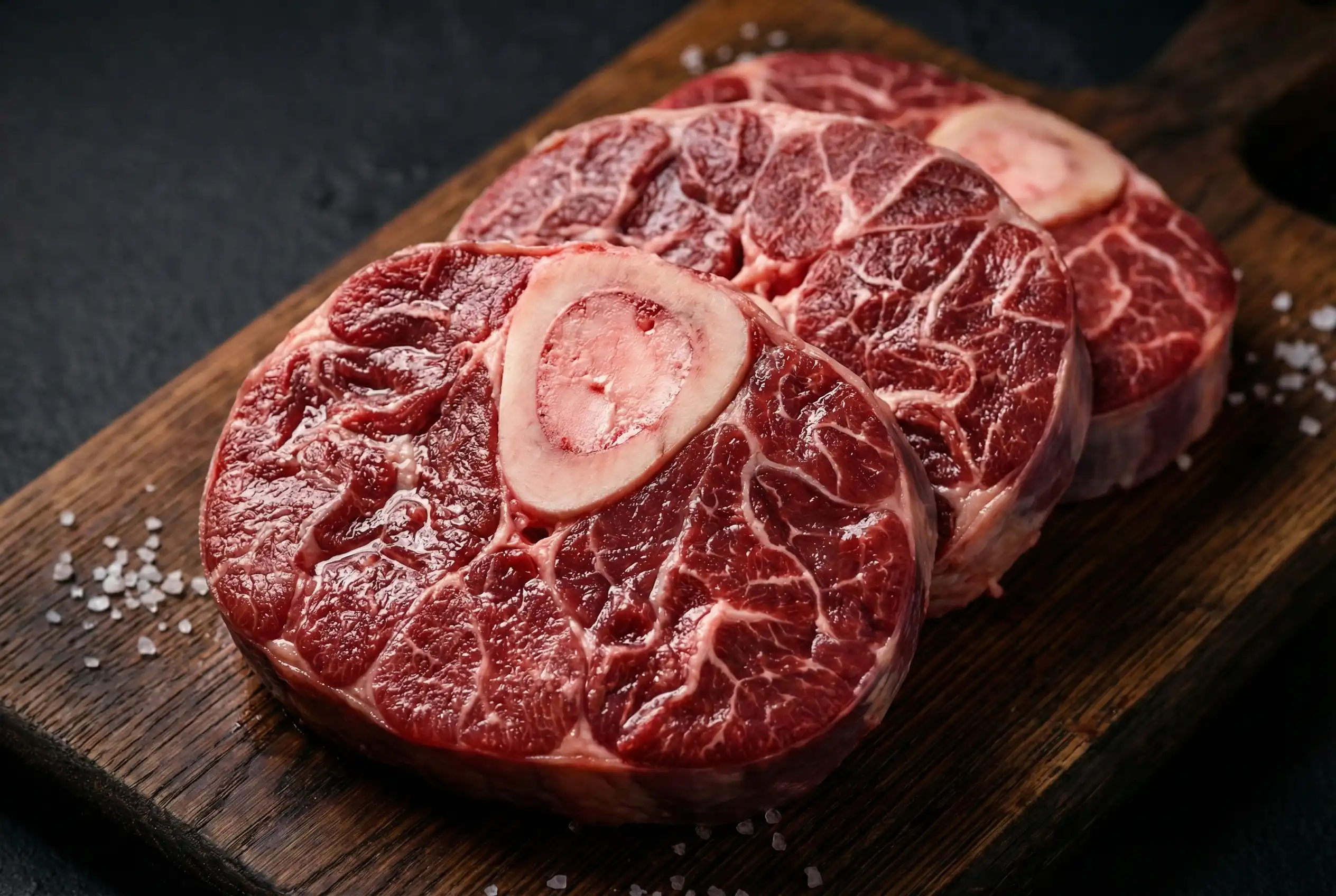
What comes from the Shin/Shank (MSA sub-primals):
Retail cuts derived:
How to cook Shin/Shank:
Australia's beef naming system diverges from both US and UK conventions in ways that confuse home cooks following international recipes. The most common traps: "porterhouse" means different things in every country, and "scotch fillet" doesn't exist as a term in the US.
| Australian Name | US Name | UK Name |
|---|---|---|
| Scotch fillet (boneless) | Ribeye | Rib Eye Steak |
| Ribeye (bone-in, AUS) | Cowboy Steak / Bone-in Ribeye | Côte de Boeuf |
| Eye fillet | Beef tenderloin / Filet mignon | Fillet steak |
| Porterhouse / New York steak | New York strip / Strip steak | Sirloin steak |
| T-bone | T-bone (small tenderloin) / Porterhouse (large tenderloin, US) | T-bone |
| Rump cap | Sirloin cap / Coulotte / Picanha | Rump cap |
| Oyster blade | Top blade / Flat Iron | Feather blade |
| Silverside | Bottom round / Outside round | Silverside |
| Topside | Top round | Topside |
| Osso buco | Cross-cut shank | Shin / Osso buco |
| Bavette | Flap steak / Bavette | Bavette |
| Knuckle | Round tip / Ball tip | Thick flank |
For the full global naming deep-dive, see our Global Guide to Beef Cuts.
The primal a cut comes from dictates how it should be cooked—not the other way around. Lean, heavily-worked muscles need moisture and time; tender, lightly-worked muscles need dry heat and speed.
| Cut | Grill/Pan-fry | Oven Roast | BBQ Low & Slow | Braise/Slow Cook | Stir-fry / Thin Slice |
|---|---|---|---|---|---|
| Scotch fillet | ✓ Ideal | ◐ Works | — | — | — |
| Eye fillet | ✓ Ideal | ◐ Works | — | — | — |
| Porterhouse/T-bone | ✓ Ideal | ◐ Works | — | — | — |
| Rump steak | ✓ Ideal | ◐ Works | — | — | — |
| Rump cap | ◐ Works | ◐ Works | ✓ Ideal | — | — |
| Oyster blade | — | — | — | ✓ Ideal | ◐ Works (thin sliced) |
| Bolar blade | — | — | — | ✓ Ideal | — |
| Chuck roll | — | — | — | ✓ Ideal | — |
| Brisket | — | — | ✓ Ideal | ✓ Ideal | — |
| Silverside | — | ◐ Works | — | ✓ Ideal | ◐ Works (thin sliced) |
| Topside | — | ✓ Ideal | — | ◐ Works | — |
| Knuckle | — | ◐ Works | — | ◐ Works | ✓ Ideal (thin sliced) |
| Flank steak | ✓ Ideal | — | — | ◐ Works | ✓ Ideal (marinated) |
| Shin/Osso buco | — | — | — | ✓ Ideal | — |
Legend: ✓ Ideal = best result | ◐ Works = acceptable with care | — = not recommended
They come from completely different primals. Scotch fillet (Cube Roll 2243) is from the mid-back rib; eye fillet (Tenderloin 2150) is from the loin. Scotch fillet has more marbling and flavour; eye fillet is the most tender cut on the animal. For a full breakdown, see our Global Guide to Beef Cuts.
Rump cap (MSA 2091) is also called picanha in Brazil. It's the fat-covered cap muscle sitting on top of the rump primal. Roast whole on the BBQ with fat cap down first to render, then reverse to finish; internal temp 60–65°C. The fat cap is what makes it special—never trim it off.
Chuck roll (2276), oyster blade (2303), shin (2360), and silverside (2050) all run under $20/kg at independent butchers. Bolar blade (2302) and knuckle (2070) are also excellent values for slow cooking.
Not quite. Australian porterhouse (also called New York steak) = US New York strip/sirloin = UK sirloin steak. It's the same cut across all regions, just named differently. Australian T-bone = US Porterhouse (confusingly).
Chuck roll (2276), oyster blade (2303), brisket (2332–2340), and shin (2360) are all high in collagen and suit slow cooking for 3+ hours. All reach peak tenderness around 90–95°C internal temperature.
Both are from the hind leg. Silverside (Outside Flat 2050) is the outer thigh—very lean, classic corned beef cut. Topside (2000) is the inner thigh—slightly more tender, suits slow roasting. Neither should be grilled without marinating or curing first.
MSA (Meat Standards Australia) grades beef on marbling, pH, and ossification into 3, 4, or 5 star ratings, with recommended cooking methods for each grade. This is different from USDA Prime/Choice/Select grading used in the US.
Technically, yes, but the long fibres are tough without prior acid preparation. A 2-hour acid marinade (citrus, vinegar, or yogurt) breaks down the fibres, making it tender. Then grill hot and fast to 55–57°C and slice thin against the grain.
Knowing which primal a cut comes from removes the guesswork from cooking it. The 8 primals are a map—use it.
Go deeper on individual cuts:
Shop by primal:
If you're looking for cuts to try, start with one primal at a time. Ask Pryde for a rump cap to BBQ, a chuck roll for a long braise, or a whole brisket for the weekend. Each primal teaches you something different about how beef cooks.
MSA cut codes and nomenclature sourced from the MLA Beef Primal and Sub-Primal Cuts Poster (Jan 2021, CC-BY-ND 4.0) and the Handbook of Australian Meat, 7th Edition.
