
"Spatchcock" is one of those words that will confuse anyone Googling it from an Australian kitchen. Type it into a search engine, and you'll get American recipes for "spatchcocked Cornish hens" — treating spatchcock as a cooking technique. Search instead for "Cornish game hen", and you'll find no Australian stockist, no local supermarket, no butcher selling it by that name.
The confusion is real. It's almost entirely the product of two countries using the same word to mean completely different things.
In Australia, spatchcock is a bird — a young, tender, single-serve chicken typically weighing 350–690g. In the United States, spatchcock is almost always a cooking technique — splitting a chicken flat along the backbone for faster, more even roasting. And the American bird that most closely resembles the Australian spatchcock? The Cornish game hen — which, despite its popularity overseas, isn't sold anywhere in Australia.
This article explains what spatchcock is, how it compares to Cornish game hen, and where to buy one — whether you're following an Australian recipe or adapting one from an American food blog.
TL;DR: In Australia, spatchcock is a young chicken weighing 350–690g — the same concept as an American Cornish game hen, which isn't available here. The dominant supplier is Game Farm (NSW), and whole birds retail for $8.50–$15 at Coles, Woolworths, and specialty butchers. Use spatchcock as a 1:1 substitute in any Cornish game hen recipe, and reduce the cooking time by 10–15 minutes.
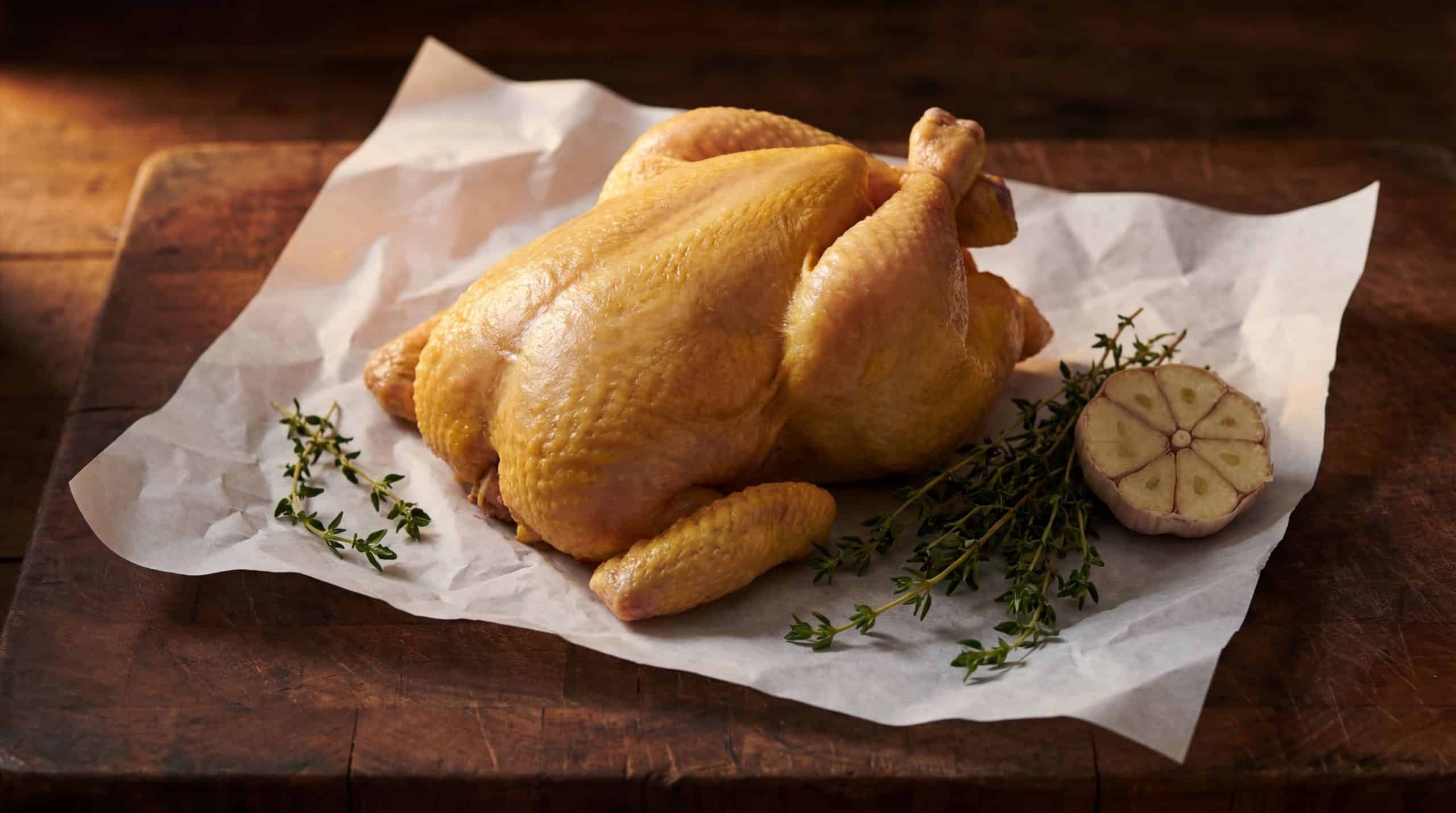
In Australia, a spatchcock is a young chicken slaughtered at 3–4 weeks of age, weighing between 350g and 690g — small enough to serve one person and tender enough to roast in under 45 minutes (Game Farm Australia, 2024; Hill Street Grocer, 2024). It's defined by age and size, not by breed — any commercial broiler raised to this weight qualifies.
The bird goes by several names depending on context. In French and British cooking it's called a poussin. In older Australian cookbooks, you'll sometimes see spring chicken. In Australian butchers and supermarkets — including at [INTERNAL-LINK: Pryde Butchery's fresh poultry range → spatchcock product page] — you'll often find all three names listed for the same product.
The dominant commercial producer in Australia is Game Farm, a NSW-based operation that has been raising spatchcock for more than 45 years (Game Farm Australia, 2024). Their birds are raised in the Hornsby Shire and Rossmore, NSW, without added hormones or growth promotants. They're stocked in both Coles and Woolworths nationally.
The flavour is noticeably different from a full-sized chicken. Younger birds have more delicate, tender meat with a slightly richer flavour — less pronounced than a game bird, but more interesting than a standard supermarket breast fillet. The skin crisps beautifully, and the small size means seasoning penetrates right through.
According to Game Farm Australia, spatchcock is raised over 45 years of production experience from NSW farms in the Hornsby Shire and Rossmore, without added hormones or growth promotants. Birds typically weigh 350–690g at harvest — a single-serve portion that roasts in 35–40 minutes at 200°C fan-forced (Game Farm Australia, 2024).
No. Despite the word "game" appearing in the American name Cornish game hen, spatchcock is classified as poultry in Australia, not game. It's commercially farmed, not wild, not free-ranging in the traditional game bird sense.
True game birds in the Australian butchery context include quail, duck, pheasant, wild boar, and venison. Spatchcock sits firmly alongside regular chicken — just smaller and younger.
Related reading: Game Birds Available at Australian Butchers
A Cornish game hen is a USDA-classified American chicken variety: a cross between a Cornish game cock and a White Plymouth Rock hen, sold at under 2 lbs (900g) ready-to-cook weight, at less than five weeks of age (USDA Agricultural Marketing Service, current regulations). Despite the name, it's not a game bird, not always a hen, and not necessarily from Cornwall — the classification is essentially a USDA marketing designation.
The Cornish game hen was created in 1950 by Therese and Jacques Makowsky at Idle Wild Farm in Pomfret, Connecticut, after a fire destroyed their guinea hen flock (Connecticut History, 2024). Experimenting with Cornish chickens crossed with White Plymouth Rock hens, they produced a compact, fast-growing bird that became a restaurant favourite within a decade. By 1956, more than 55 Connecticut farms were raising over three million chicks annually. Today, Cornish game hens are mass-produced by companies including Tyson Foods and are a supermarket staple across the USA.
In Australia, they don't exist as a retail product. Australia's biosecurity laws, administered through the Department of Agriculture, Fisheries and Forestry (DAFF), prohibit the importation of raw poultry meat from the United States (DAFF BICON database, 2024). No supermarket, butcher, or online retailer in Australia carries Cornish game hens. The Cornish breed is available as a backyard chicken in Australia — but that's not the same as the retail product.
Cornish game hens are deeply embedded in American entertaining culture. They appear regularly in Thanksgiving and Christmas recipes, in food media like Epicurious and NYT Cooking, and across American YouTube cooking channels and streaming food shows that Australian audiences increasingly follow.
💡 Butcher's insight: There is currently no Australian article that directly tells home cooks to use spatchcock as a Cornish game hen substitute. The entire search landscape for "spatchcock vs Cornish game hen" is dominated by American technique articles that treat spatchcock as a cooking method — not as a bird. Australian cooks following US recipes are hitting a vocabulary wall with no local content to help them.
Cornish game hen is a USDA-defined American product — a Cornish-cross chicken under five weeks old and under 900g (2 lbs) — first developed at a Connecticut farm in 1950. It is not commercially available in Australia. Australian biosecurity laws prohibit raw US poultry imports (DAFF BICON, 2024), leaving Australian cooks without a like-for-like product — unless they know to reach for spatchcock instead.
Australian spatchcock averages around 450g ready-to-cook, while a Cornish game hen typically retails at 625g (22 oz) in the USA — but for practical cooking purposes, the two birds are nearly interchangeable: same tender youth, same single-serve portion, same elegant presentation (USDA Agricultural Marketing Service; Game Farm Australia, 2024). The differences come down to breed, average weight, and which country you're shopping in.
The Cornish cross genetics give the American bird a marginally more compact muscle structure and slightly denser texture. In practice, for most home cooking, you won't notice the difference — especially once the bird is seasoned, marinated, and roasted.
💡 Butcher's insight: No existing Australian article directly compares spatchcock and Cornish game hen from an Australian butchery perspective. Every result for "spatchcock vs Cornish game hen" in Australian search results is an American technique article about butterflying a Cornish hen. The comparison table below is the first of its kind published from an Australian butchery perspective.
| Attribute | Australian Spatchcock | Cornish Game Hen (USA) |
|---|---|---|
| Age at harvest | 3–4 weeks | Under 5 weeks |
| Weight | 350–690g (avg ~450g) | 600–900g (avg ~625g) |
| Breed | Commercial broiler, age/size-defined | Cornish × White Plymouth Rock cross |
| Game bird? | No — classified poultry | No — USDA poultry classification |
| Available in Australia? | Yes — supermarkets & butchers | No |
| Retail price (AU) | ~$8.50–$15 whole | N/A |
| Serves | 1 adult | 1–2 (size dependent) |
| Roasting time (whole) | 35–40 min at 200°C fan | 45–60 min at 220°C (425°F) |
In Australia, "spatchcock" almost always refers to the small young bird. Abroad — particularly in the USA and UK — it more commonly describes a preparation technique: removing the backbone from a larger chicken so it lies flat, allowing it to cook faster and more evenly. This is also known as butterflying. Same word, entirely different meaning.
The etymology is genuinely unclear. The most widely cited theory traces "spatchcock" to 18th-century Irish cooking — a hasty way of preparing a cockerel that may have been called "dispatch cock." The word appeared in print as early as 1785, when lexicographer Francis Grose defined it in his Classical Dictionary of the Vulgar Tongue as "an Irish dish upon any sudden occasion" (Grose, F., Classical Dictionary of the Vulgar Tongue, 1785). Whether the small bird was named after the technique, or the technique borrowed the bird's name, is still debated by food historians.
What matters practically:
Because global food media is dominated by American content, nearly every article that appears for "spatchcock vs Cornish game hen" is about butterflying a Cornish hen — not about the Australian bird. The vocabulary overlap creates a genuine search dead-end for Australian cooks following US recipes or US food content.
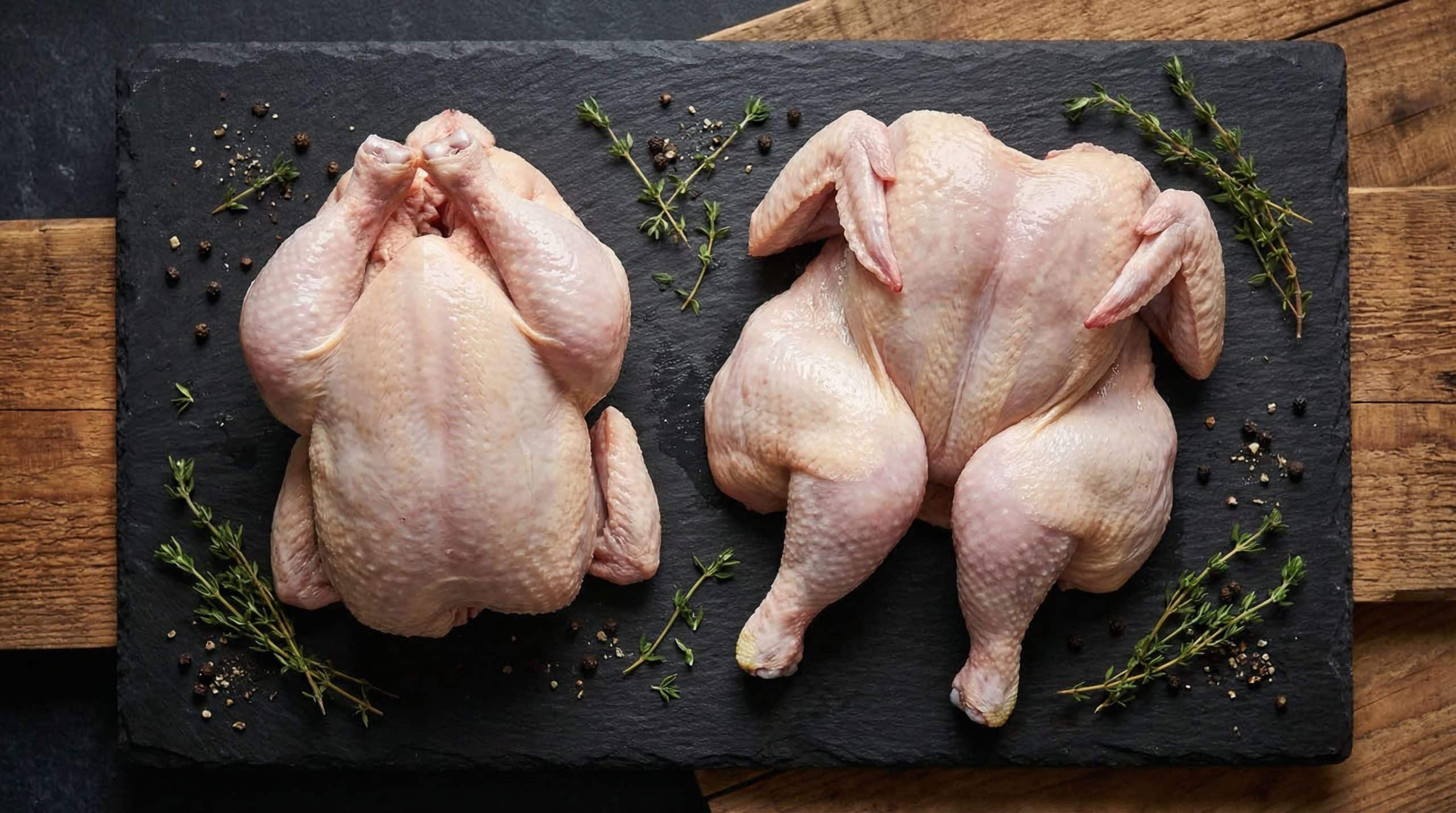
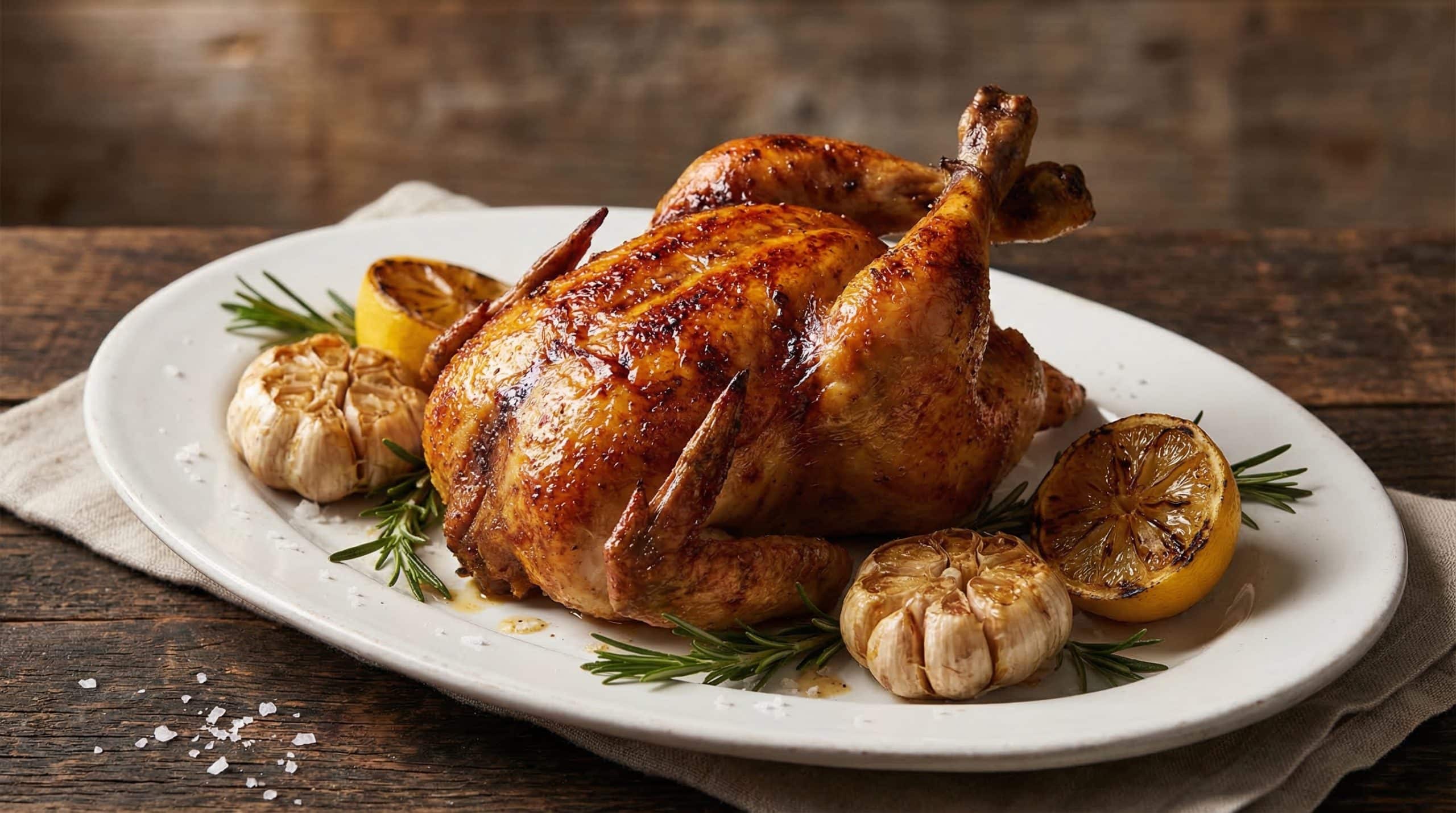
A whole spatchcock roasts in 35–40 minutes at 200°C fan-forced for a 450–500g bird — roughly half the time of a standard roast chicken, with a safe internal temperature of 74°C confirming doneness (Food Standards Australia New Zealand, 2024). This makes it one of the most practical proteins to roast for weeknight cooking and entertaining alike.
The most popular Australian cooking methods:
Rest the bird for 5–10 minutes after cooking. Small birds lose heat quickly; tent loosely with foil to retain warmth without steaming the skin. One bird serves one adult generously. For entertaining, the appeal is obvious: each guest gets their own bird, zero carving, beautiful on the plate.
Flavour pairings that work well: lemon and garlic, herb butter under the skin, Moroccan spice rubs, piri piri, persillade (parsley and garlic paste), and Mediterranean herb mixes.
Use spatchcock as a 1:1 substitute. The main adjustments:
For any American recipe calling for Cornish game hen, Australian spatchcock is a direct substitute. Reduce roasting time by 10–15 minutes (the Australian bird averages ~450g vs ~625g for a US Cornish hen), convert 425°F to 200°C fan-forced, and target a core temperature of 74°C (Food Standards Australia New Zealand, 2024).
Spatchcock is available nationally at major supermarkets and through specialty butchers — whole birds ranging from 350g to 690g, typically priced between $8.50 and $15 per bird (Joe's Fresh Poultry; Gamekeepers of Australia, 2024).
Supermarkets:
Specialty butchers and online:
What to look for when buying: Choose a bird with a plump, rounded breast, moist (not slimy) skin, and no grey discolouration. Buy within 2 days of cooking, or freeze immediately upon purchase. Supply can tighten around Christmas and Easter when whole birds are in high demand — order ahead if you're cooking for a group.
Size guide: A 450–500g bird is right for one adult. For a more generous serve, look for a 600g+ bird or plan on two per person.
Order online: Buy fresh spatchcock with home delivery — Pryde Butchery
They're functionally equivalent. Both are young, single-serving chickens with tender, delicate meat — the same concept, just with different names in different countries. The main differences are breed (Cornish game hen is a specific Cornish-cross variety; Australian spatchcock is not breed-specific), average weight (Cornish game hens run 625–900g vs 350–690g for spatchcock), and availability (spatchcock is widely stocked across Australia; Cornish game hen is not sold here). Use spatchcock as a direct substitute in any recipe.
The closest American equivalent is the Cornish game hen — also called Rock Cornish game hen. In the USA, "spatchcock" almost always refers to the preparation technique of splitting a chicken flat along the backbone, rather than a specific bird. Australian and British usage of "spatchcock" as a noun for a small young chicken isn't standard American food terminology, which is why searching online creates such confusing results for Australians.
Yes. A standard 450–500g spatchcock yields approximately 250–300g of edible meat after cooking — a generous adult serving. For larger appetites, or if serving the bird with minimal sides, choose a 600g bird or allow two smaller birds per person. The individual-serve format is one of spatchcock's main advantages for dinner parties, since each guest gets their own bird with no carving required.
They're the same bird described in different languages. Poussin is the French and British term for a very young chicken under 28 days old, weighing 350–690g. Spatchcock is the Australian term for the same product. Spring chicken is a third synonym used interchangeably in older cookbooks and some butchers. In Australian supermarkets and butcher shops, you'll often see all three names listed for the same product.
No. Cornish game hen is a USDA-defined American product that doesn't exist as a retail item in Australia. Australian biosecurity laws under DAFF prohibit the importation of raw poultry from the United States (DAFF BICON, 2024). There's no supermarket, butcher, or online retailer here that carries Cornish game hens. Australian spatchcock is the direct local equivalent — search for it at Coles, Woolworths, specialty butchers, or order it fresh online.
The gap between Australian and American cooking vocabulary is real, and spatchcock sits right in the middle of it. In Australia, it's the bird. In the USA, it's the technique. The bird Australians call a spatchcock is the same single-serve, tender young chicken that Americans know as a Cornish game hen — just smaller on average, and available at your local butcher rather than a Connecticut farm store.
If you're following a US recipe that calls for Cornish game hen, buy a spatchcock. Adjust the cooking time down by 10–15 minutes, convert the oven temperature from Fahrenheit to Celsius, and you'll get the same result: an elegantly plated individual meal that cooks in under 40 minutes and needs zero carving at the table.
