If there's one thing I've learnt over the last few years of being in the meat trade is that everyone has an opinion on how to cook a steak. Ask YouTube and you'll get hundreds of videos from backyard BBQ enthusiasts to Michelin-star chefs — all convinced their way is the right way.
Resting meat is no different. There seem to be two clear camps: the "always rest it" side, and the "just cut it up, it's fine" side. I've heard both argued with real conviction. And here's the honest part — both sides make fair points.
We're not just talking steaks, either. Be it a scotch fillet, roast lamb, a whole chicken, or yes, even fish — the question of how long to rest meat after cooking applies across the board. So let's cut into this issue (pardon the pun) and work out what's actually going on.
TL;DR: Resting meat does reduce juice loss in practice — America's Test Kitchen found a 10-minute rest cut juice loss by 60% in a controlled pork loin test (ATK, 2024). But the old explanation — that juices "migrate back" into the meat — is wrong. The real benefit is temperature management: a rest lets carryover cooking complete and internal vapour pressure drop before you slice.
Most people have heard the old line about "locking in juices." It's repeated so often it feels like fact. But it isn't — and the first step to resting meat properly is clearing that up. Resting is not about sealing anything in. It's about what happens to heat and liquid in the moments after meat leaves your pan or oven.
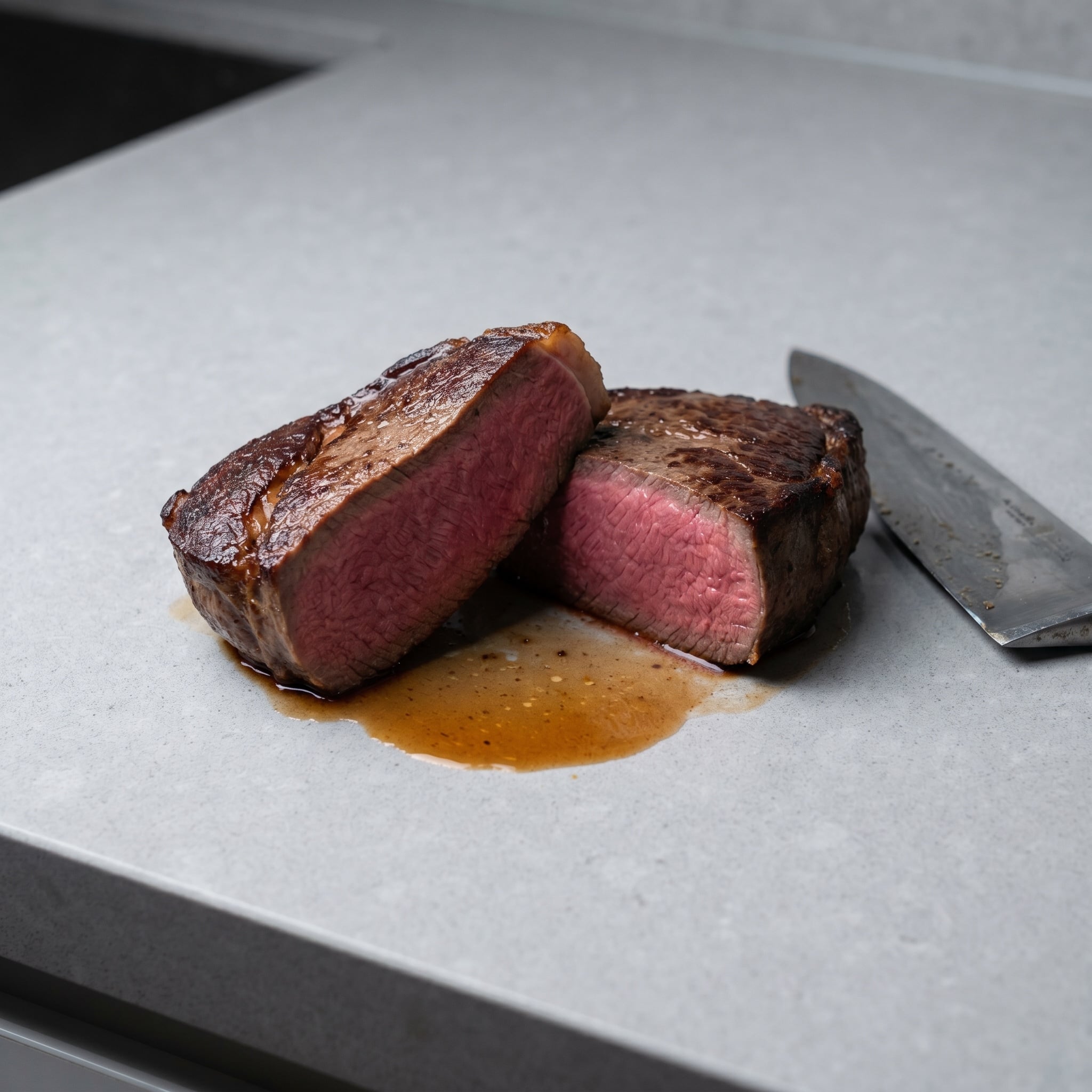
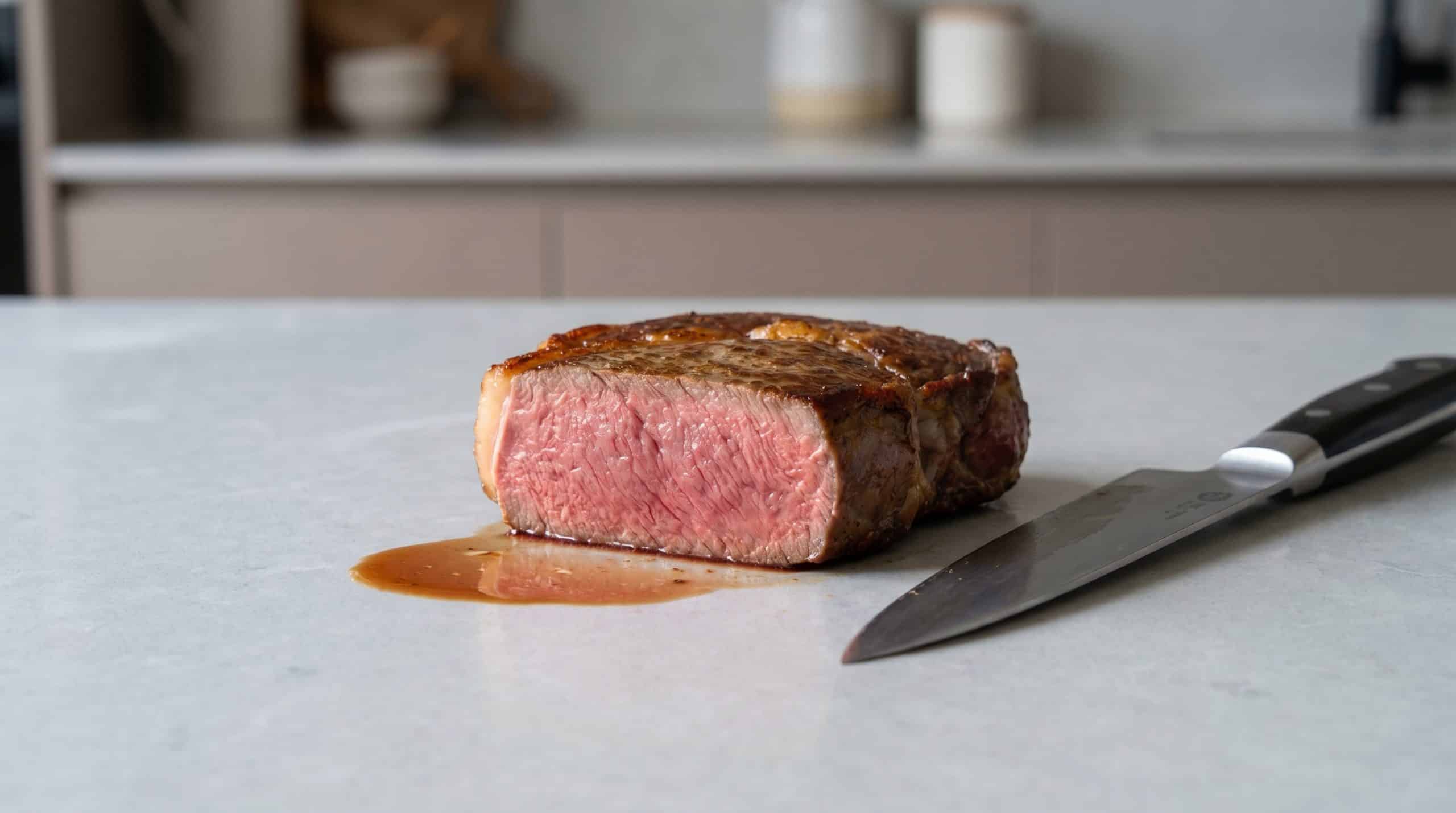
When meat comes off the heat, two things are happening at once. The internal temperature is still rising — this is carryover cooking. And the moisture inside the meat, which was under heat and pressure during cooking, begins to settle as the temperature drops. Resting is simply the act of giving those two processes time to finish before you make the first cut.
The practical result is less juice on the cutting board and more in your mouth. That's worth understanding properly.
The Resting Debate — What the Science Actually Shows
The science here is more contested than most cooking articles will admit. Two rigorous experimenters — America's Test Kitchen and food scientist Chris Young — have run real controlled tests and reached conclusions that look different on the surface. Here's where they each land.
The Case For Resting (America's Test Kitchen)
America's Test Kitchen ran one of the most-cited controlled experiments on meat resting: five identical pork loins cooked to the same internal temperature, then sliced at different time intervals (ATK, 2024). The results were clear. The immediately-sliced loin lost 10 tablespoons of juice. After a 10-minute rest, that dropped to 4 tablespoons — a 60% reduction. After 20 minutes, 2.5 tablespoons. After 30 minutes, just 1 tablespoon.
ATK's steak experiments told a similar story: rested steaks lost around 40% less juice than steaks sliced immediately (ATK, 2024). Their proposed mechanism — that the gelatin and fat in meat juices firm up as they cool, making the liquid more viscous and slower to escape — is intuitive and consistent with their data.
💡 Food science: America's Test Kitchen roasted five identical pork loins to the same internal temperature, then sliced them at different rest intervals. The immediate slice lost 10 tablespoons of juice. After just 10 minutes, that dropped to 4 tablespoons — a 60% reduction.
The Sceptic's Case (Chris Young)
Chris Young isn't your average YouTube cook. He holds degrees in theoretical mathematics and biochemistry from the University of Washington, spent four years working under Heston Blumenthal at The Fat Duck, and is the principal co-author of Modernist Cuisine — the 6-volume food science series that won the 2012 James Beard Award for Cookbook of the Year. He's also the founder of ChefSteps and Combustion Inc., maker of a predictive wireless thermometer. When he talks about meat science, it's worth listening.
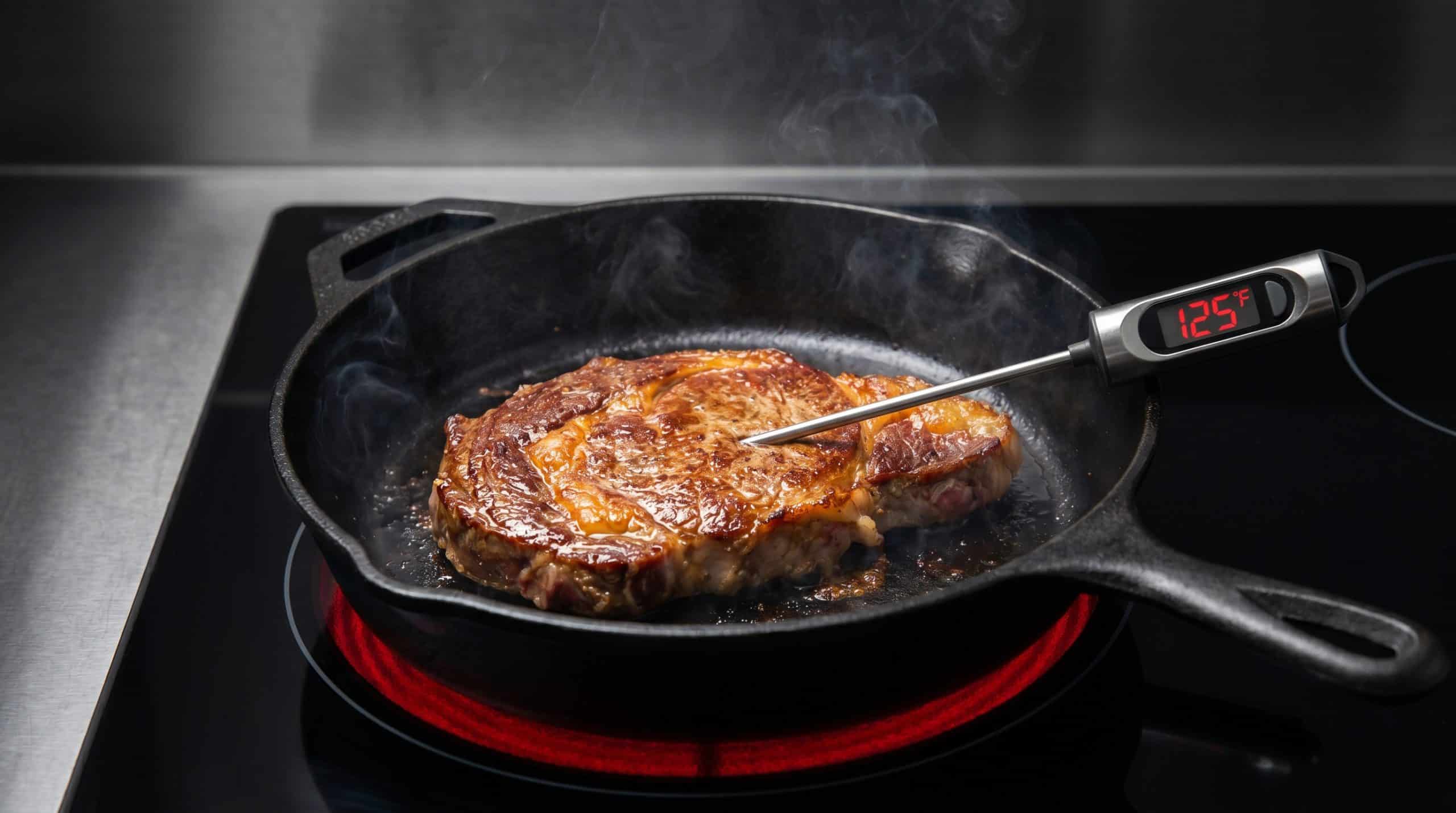
In a 2024 YouTube experiment, Young used his predictive thermometer to cut steaks at identical internal temperatures — one rested, one not (Chris Young Cooks, 2024). When the internal temperature at the moment of slicing was the same, juice loss was essentially identical. His conclusion: the clock doesn't matter — the temperature does.
His proposed mechanism is the vapour pressure. When meat is very hot internally, the moisture has high kinetic energy and high vapour pressure. Slicing into hot meat opens escape routes and pressurised liquid rushes out. A rest reduces this by lowering internal temperature — whether that takes five minutes or twenty doesn't matter as much as hitting the right temperature before you cut.
His practical recommendation: pull your meat 5–8°C below target doneness, rest only until carryover cooking brings it to the right temperature, then slice straight away.
It's worth noting that Young previously co-authored a different explanation in Modernist Cuisine — that cooling thickens juices, slowing their escape. He has publicly reversed that position in his 2024 video. It's a rare and honest self-correction from one of the field's most rigorous thinkers.
🔪 From the butcher: This doesn't mean skip the rest — it means the rest is doing something different than we thought. The real benefit is controlling when your meat hits its final temperature, not magic juice redistribution.
Where Both Sides Actually Agree
The debate is real, but there's more common ground than it first appears. Both ATK and Chris Young agree that the old "locking in juices" story — where cutting releases a pool of liquid that somehow gets reabsorbed during a rest — is simply wrong.
Both sides also agree: use a thermometer, not just a timer. A clock tells you nothing about what's actually happening inside the meat.
Kenji López-Alt, author of The Food Lab (2015) and MIT-educated food scientist, offers a useful middle position. His reverse sear method — a long slow oven phase followed by a quick high-heat sear — builds in so much gentle heat work that no significant post-sear rest is needed. The slow oven phase already does what a conventional rest is meant to achieve. Kenji has written explicitly: "There was no need to rest the steaks before serving, as all that business of letting the juices redistribute was covered during the slow roast."
In July 2025, Serious Eats published "This Major Rule About Cooking Meat Turns out to Be Wrong" (Gritzer, Serious Eats, July 2025). Their blind taste test — 4 tasters, 30 rounds — found rested steaks were judged juicier only 16 times out of 30. That's statistically indistinguishable from chance. Controlling for internal temperature at the moment of slicing, rested and unrested samples lost essentially the same juice.
And yet — even after his own platform published that data — Kenji's pragmatic position from 2012 holds up: "In either case, the fact remains: resting your meat works." (Serious Eats, 2012). The mechanism may be misunderstood, but the practical outcome is real.
It's also worth putting the absolute numbers in perspective. Kenji's original 2009 Serious Eats experiment — the data that seeded much of this debate — found an unrested steak lost roughly 9% more juice than a rested one (López-Alt, Serious Eats, 2009). In absolute terms, that amounts to less than 2.5 tablespoons across the whole steak — less than one-tenth of a teaspoon per bite. A separate gravimetric measurement by food scientist Prof. Greg Blonder found a difference of just 0.15 oz between rested and unrested ribeye (Blonder via AmazingRibs.com). These numbers don't make resting irrelevant — but they do put it in proportion. The margin is real; the drama is somewhat overstated.
In the Kitchen: What Popular Cooks Actually Do
The scientific debate is useful context, but it's also worth seeing how high-profile cooks handle resting in practice. The approaches vary more than you'd expect — and the differences reflect a lot of what the science is actually saying.
Binging with Babish (Andrew Rea) takes a cut-specific approach. For a skirt steak, he rests 10 minutes under loose foil while making the pan sauce. For a tomahawk ribeye, he recommends no more than 5 minutes — and actively warns against over-resting a large thick cut. His reverse sear ribeye gets 10 minutes with a "butter blanket": the pan butter spooned over the steak and then loosely covered. The lesson from Babish is a practical one: match the rest to the cut, and don't assume more time is always better (Binging with Babish).
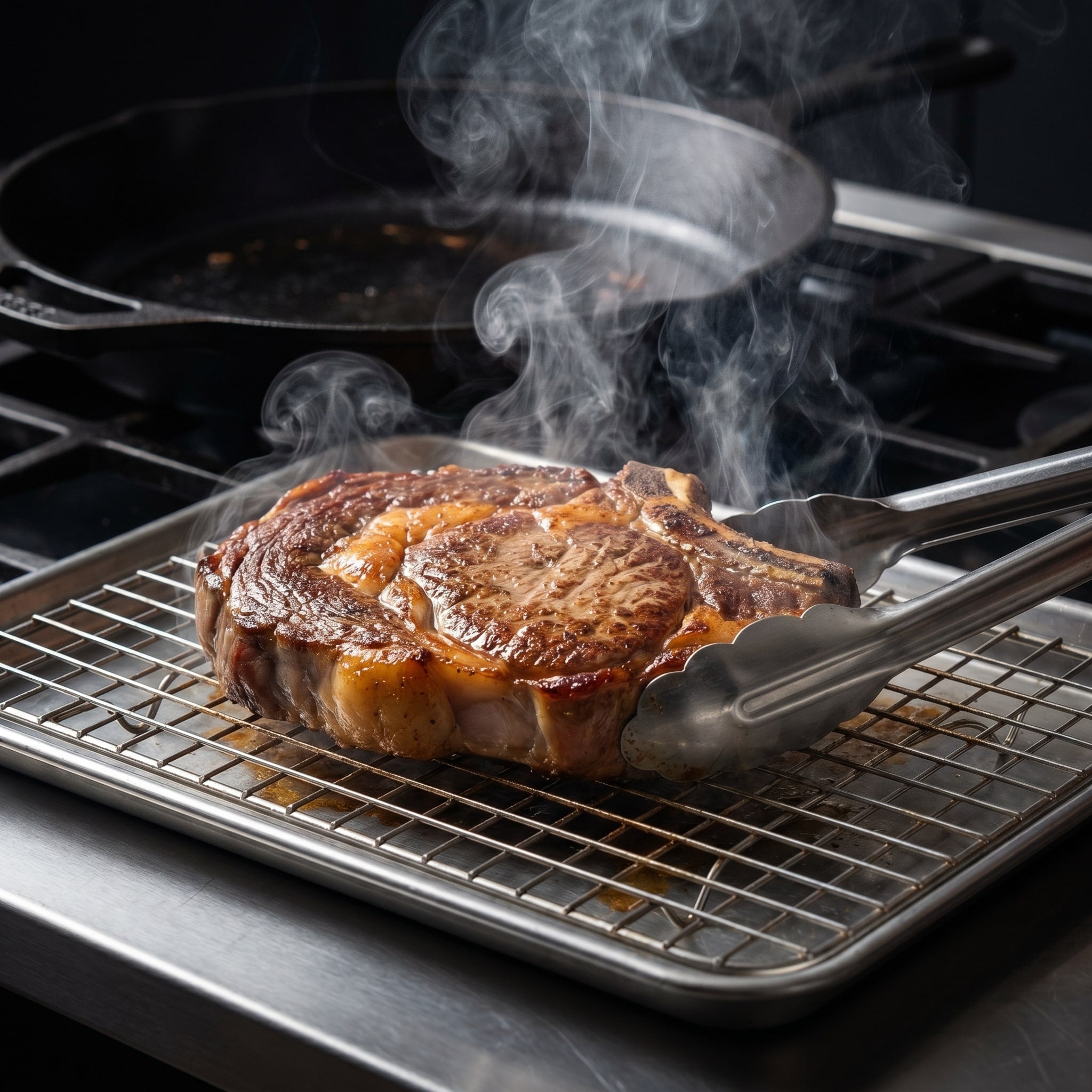
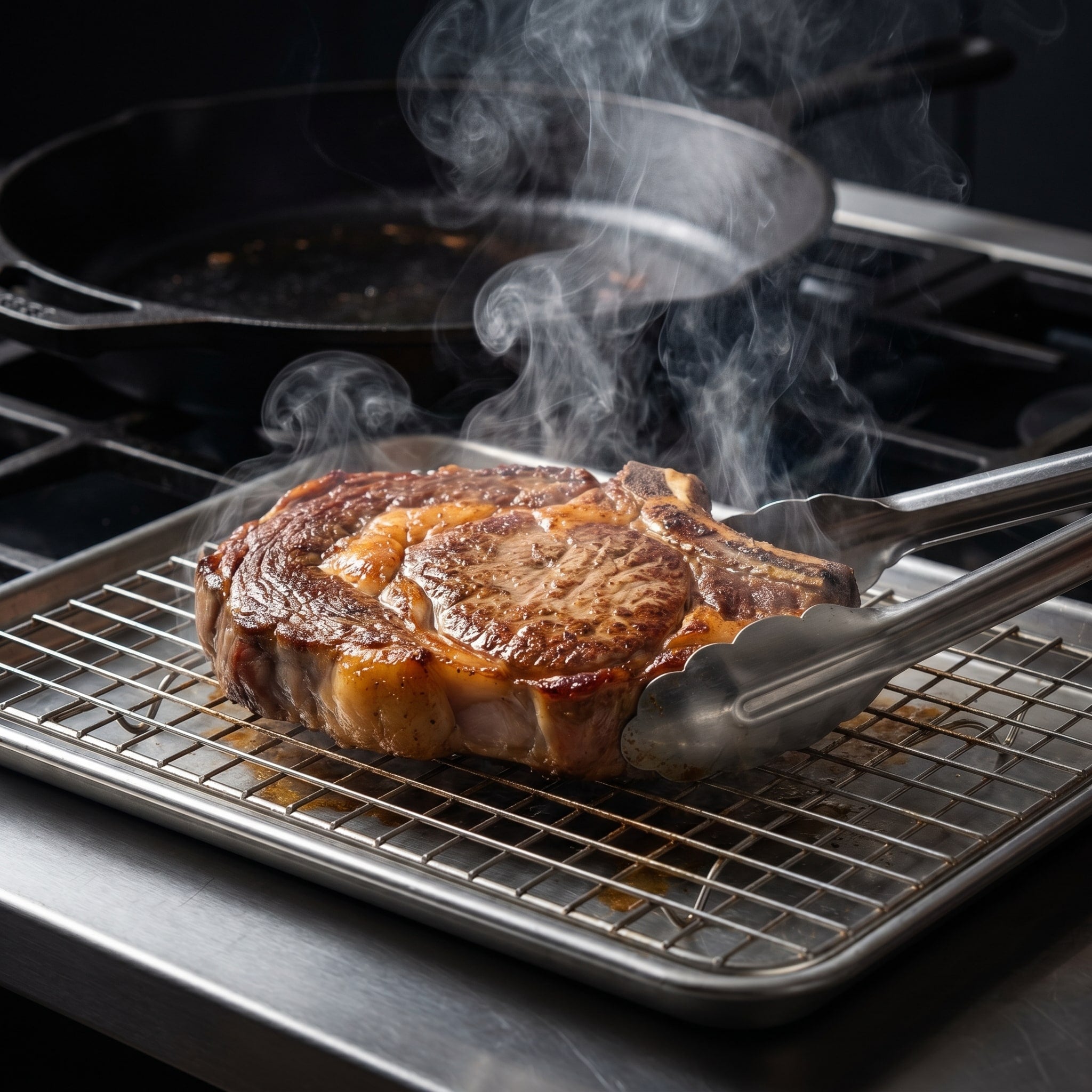
Max the Meat Guy focuses on technique as much as timing. His standard approach is a 10-minute rest on a wire rack rather than a flat surface — specifically to maintain the integrity of the bottom crust, which would otherwise steam against the plate. For premium cuts like dry-aged Wagyu, he cuts the rest to 5 minutes and rests uncovered on a warm plate, skipping foil entirely to protect the crust (Max the Meat Guy). Both the rack technique and the foil-free approach for high-quality cuts are worth borrowing.
Guga Foods (Gustavo Tosta), who runs some of the most controlled steak comparisons on YouTube, takes the shortest approach of all: 2–3 minutes after a reverse sear, with a knob of butter melting on top during the rest (RNZ interview, July 2023). It's the most practical position in this group — prioritising a hot steak over an optimally rested one. Interestingly, despite running controlled experiments on dozens of steak variables, Guga has never produced a dedicated "rested vs. unrested" experiment — suggesting he considers resting settled enough not to test.
Harold McGee, author of On Food and Cooking — the most influential food science book in the English language — focuses his resting guidance on large roasts rather than steaks. His position is clear: rest large oven roasts for at least half an hour, allowing carryover cooking to finish the centre and the internal temperature to stabilise around 50°C before carving. His broader principle underpins everything else here: the most important factor in keeping meat moist is not letting internal temperature climb too high. Once you pass approximately 60–65°C, moisture loss accelerates dramatically as muscle proteins denature and squeeze liquid from the fibres. Resting helps — but not cooking it too far in the first place helps more.
Carryover Cooking — The Part That Actually Matters Most
Here's what doesn't get enough attention in most resting guides: carryover cooking. When you pull meat off the heat, the internal temperature keeps rising. How much it depends entirely on the size and mass of the cut.
A thin steak (about 2cm) will rise roughly 2–3°C after leaving the pan. A thick steak (4cm) rises 3–4°C. A small roast of around 1kg will continue climbing 4–7°C. A large roast — 3kg or more — can overshoot your target by 5–8°C if you're not watching it (webstaurantstore.com). This is why experienced cooks always pull early on big cuts.
The practical rule is simple: use a meat thermometer, pull your roast 3–6°C below target temperature, and let carryover do the rest. With sous vide or reverse sear methods, carryover is minimal — you're cooking slowly throughout, so the temperature gradient between surface and centre is already small. No long post-sear rest is needed.
💡 Food science: The bigger and thicker the cut, the more heat is stored in its mass, and the further its temperature will rise after leaving the heat. A thin schnitzel barely moves; a 3kg rolled roast can overshoot your target by 8°C if you're not careful.
Related reading: Why a meat thermometer is the most useful tool in your kitchen — cooking to temperature, not time.
How Long to Rest Meat: A Cut-by-Cut Guide
The right rest time depends on the cut, not a single universal rule. Meat & Livestock Australia recommends 10–20 minutes for roasts and 3–5 minutes for steaks as a starting point (MLA via australianbeef.com.au). The table below builds on that with Australian cut names and practical notes.
Cut
Rest Time
Notes
Thin steak (schnitzel, minute steak)
Skip / 1–2 min
Carryover negligible; serve immediately
Scotch fillet / eye fillet
5–7 min
Remove foil if you want to preserve the crust
Porterhouse / T-bone
5–8 min
Bone retains heat — factor this in
Thick-cut ribeye / tomahawk
5–10 min
Don't over-rest — these cool slower than you think
Lamb chops
4–5 min
Cool quickly; foil optional
Lamb rack
8–10 min
Rest loosely covered
Lamb leg (roast)
20–30 min
Rest uncovered or very loose foil — this one needs time
Chicken breast
5 min
Significant juice loss if cut immediately
Whole chicken
15–20 min
Carries over cooking; don't rush this
Pork chop
5 min
—
Pork belly / rolled pork roast
15–20 min
Do not cover — crackling will soften
Brisket / large slow-cook roast
30–60 min
Can be held in a warm oven; more rest = better texture
Resting is a good default — but it's not universal. There are a few specific situations where resting actively works against you.
Pork Crackling and Chicken Skin
Steam is the enemy of crispiness. When you cover hot meat with foil, the steam coming off it has nowhere to go — it condenses on the skin or crackling and undoes everything you worked for.
For pork belly and rolled pork roast, rest uncovered with the crackling side up. If it looks like it needs protection, carve the crackling off as a slab before resting, then serve it alongside the meat. For whole roast chicken, rest skin-side up with no covering.
🔪 From the butcher: If you've worked hard to get good crackling on a pork belly, never cover it with foil to rest. Steam will undo 40 minutes of rendering in about 90 seconds. Rest the meat uncovered, crackling side up, in a warm spot.
Thin Cuts
Minute steak, schnitzel, and stir-fry strips don't benefit from resting. Carryover cooking is negligible on cuts this thin, and heat loss is real and fast. Serve straight from the pan.
Fish
Seared tuna is a special case. The point of searing is a sharp, defined crust with a cold-raw centre. If you let it sit, residual surface heat migrates inward and blurs that contrast. Slice it immediately and let the surface heat dissipate into the air, not the flesh.
Most other fish fillets follow the same logic — delicate protein structures don't benefit from resting the way dense muscle cuts do. Plate and serve immediately.
When You've Overcooked a Roast
If your roast has overshot its target temperature, don't let it keep cooking by resting it on the bench. Slice immediately, let it cool, and drizzle any escaped juices back over the slices. Resting an overcooked roast just makes it more overcooked.
What Are the Most Common Resting Mistakes?
Most resting mistakes come down to applying a one-size rule to very different cuts, or misunderstanding what foil actually does. Here are the six errors worth avoiding.
Wrapping tightly in foil. Tight foil traps steam and softens any crust or skin you've developed. If you use foil at all, tent it very loosely — or skip it entirely for premium cuts with a good sear.
Over-resting and serving cold food. More rest isn't always better. A thin scotch fillet rested for 20 minutes will be lukewarm at best. Know your cut's resting window and work within it.
Applying the same rule to every cut. A chicken breast and a lamb leg are completely different problems. Resting times scale with mass and cooking method — not a universal five-minute rule.
Not using a thermometer. A clock tells you nothing about internal temperature. A thermometer tells you everything. This is the single most useful change most home cooks can make.
Cold cutting board pulling heat out faster. A cold marble or stone board will drop your meat's surface temperature quickly. A warm plate or timber board is a better landing spot for rested cuts you want to serve warm.
Not accounting for carryover on large roasts. Pulling a 3kg lamb leg at the exact target temperature is a mistake — by the time you rest and carve, it's overcooked. Pull early, let carryover close the gap.
The Butcher's Perspective
When you handle a lot of different cuts, you start to see them less as a single category and more as individual problems. Here's how I think about resting based on what's actually in the cut.
High-collagen cuts — brisket, lamb shoulder, short rib, osso buco — need a long rest of 30 minutes or more. These cuts have spent hours cooking to break down connective tissue into gelatin. That gelatin is still mobile when you pull them off heat. Give it time to set and the texture firms into something you can actually slice and serve properly. Rush it, and the whole thing falls apart on the board.
Lean, fine-fibred cuts — eye fillet, chicken breast — are almost entirely about temperature management. There's very little fat or connective tissue to provide structure. The rest is short and the goal is simple: get to target temperature without overshooting.
Fat-marbled cuts — scotch fillet, wagyu, heavily marbled short ribs — benefit from resting on a wire rack rather than a flat surface, a technique Max the Meat Guy uses specifically to maintain crust integrity on the bottom of the steak. Air circulates underneath and prevents the crust from steaming in its own heat. Rest uncovered, or with very loose foil, to keep the surface you worked for.
Bone-in cuts — lamb rack, T-bone, porterhouse, whole chicken — have a complicating factor: the bone retains heat longer than the surrounding muscle. Factor this into your pull temperature. The meat right against the bone will continue cooking after the rest of the cut has stabilised.
🔪 From the butcher: Understanding your cut matters more than following a rule. A scotch fillet and a brisket are completely different problems. Know what you're cooking and the rest time follows naturally.
After all that science and debate, here's what actually matters in practice.
Get a thermometer. It's the only tool that tells you what's genuinely happening inside your meat. A $30 instant-read changes everything.
Bigger cut = longer rest. A thin steak needs 5 minutes; a lamb leg needs 20–30. Scale with mass.
Pull early on large roasts. Account for carryover. A 3kg roast can overshoot target temperature by 5–8°C if you pull at the final number.
Use loose foil or no foil. Tight foil traps steam. Premium cuts with a good crust are better rested uncovered or on a rack.
Reverse sear and sous vide don't need a long rest. The cooking method already did the work — a short rest to manage the sear temperature is enough.
Crackling and crispy skin: never cover. Rest uncovered, skin or crackling side up, in a warm spot.
Serve warm, not lukewarm. Rest is about better eating, not following a timer rule. If the food's going cold, it's too long.
FAQ
Does resting meat really make it juicier?
In practice, yes — though the reason is more nuanced than most guides admit. America's Test Kitchen found that a 10-minute rest reduced juice loss by 60% compared to slicing immediately (ATK, 2024). The mechanism isn't juice "reabsorption" — that's a myth. The real driver is reducing internal vapour pressure before you cut, which happens as the meat cools toward its final temperature.
How long should you rest a steak?
For a standard scotch fillet or eye fillet (around 3–4cm thick), 5–7 minutes is a reliable guide. Meat & Livestock Australia recommends 3–5 minutes as a starting point for most steaks (MLA via australianbeef.com.au). Kenji López-Alt's rule of thumb — rest for roughly one-third of total cooking time — is a good rough guide for cuts without a thermometer.
Should you cover meat while resting?
It depends on what you're resting. For a steak or roast without crackling, a very loose foil tent or nothing at all is fine — the goal is slowing heat loss, not trapping steam. For pork belly, roast pork, or whole chicken, never cover. Steam from the hot meat will soften your crackling or crispy skin in under two minutes.
Do you need to rest chicken?
Yes — especially chicken breast. ATK's side-by-side tests showed chicken and pork released significantly more juice than steak when sliced immediately. A 5-minute rest for a chicken breast and 15–20 minutes for a whole bird is recommended (ATK, 2024). Whole roast chicken also needs carryover cooking time to safely reach temperature through the thickest part of the thigh.
Can you rest meat for too long?
Yes. The risk is food going lukewarm or cold — which affects both eating quality and, for poultry, food safety if the meat drops into the temperature danger zone (between 5°C and 60°C). Thin steaks and chops cool quickly; don't push past 10 minutes for smaller cuts. Brisket and large roasts are more forgiving and can be held in a warm oven (around 70°C) for extended periods if needed.
Does the reverse sear method need a rest?
Not a long one. Kenji López-Alt has written explicitly that with the reverse sear, "there was no need to rest the steaks before serving, as all that business of letting the juices redistribute was covered during the slow roast." (Serious Eats, 2012). After the final sear, a brief 2–3 minute rest lets the crust set — that's it. The same applies to sous vide, where there's no surface-to-centre temperature gradient to manage.
Does fish need to rest after cooking?
Most fish doesn't benefit from resting and shouldn't be made to wait. For seared tuna especially, slice immediately — resting allows residual surface heat to migrate inward, destroying the defined contrast between crust and raw centre that makes the dish. Most other fish fillets — salmon, barramundi, snapper — are best plated straight from the pan. The protein structure is more delicate than red meat and doesn't respond well to sitting.
David deMarco is the owner of Pryde Butchery in Miranda, NSW. With a background in IT and lived around the world, he brings deep knowledge of meat, cooking and modern food retail. Known for championing quality, service, and innovation, David has grown Pryde into one of Sydney’s top butcheries, both in-store and online.