
You've spent good money on a scotch fillet. The pan's smoking, the steak's on, and thirty seconds before it needs to come off, the doubt hits: is medium-rare 52°C or 55°C? Do you pull it now or give it another minute? If that moment of hesitation sounds familiar, this chart ends the guesswork for good — every doneness level, Celsius first, with the exact temperature to pull at and the temperature it actually finishes at after resting.
Just want the numbers? Jump straight to the chart — most people land on this page mid-cook with a thermometer in one hand and no patience for a full read, and that's exactly what this page is built for.
Medium-rare steak is 52–55°C (125–130°F) at the centre. Pull it at 50°C — carry-over cooking adds roughly 2–3°C during a 5–10 minute rest (ThermoWorks). The full doneness range runs Blue 49°C, Rare 52°C, Medium-Rare 55°C, Medium 62°C, Medium-Well 69°C, to Well Done 74°C+, each pulled 2–3°C early to account for that carry-over. The USDA's whole-cut safety benchmark is 62.8°C (145°F) with a 3-minute rest; Australia's AS 4696:2007 standard instead requires a seared surface holding 65°C for 10 minutes, since searing — not a single core temperature — is what actually makes a rare whole-muscle steak safe to eat. No thermometer on hand? The finger test works as a reliable backup, though only 27% of home cooks actually use one. Full chart, cut-specific adjustments, and sourcing below.
Below the chart, you'll find the food-safety science behind these numbers (USDA versus Australia's own FSANZ), the finger test for when you don't own a thermometer, cook times by thickness, and how the ideal doneness shifts depending on the cut sitting in your pan.
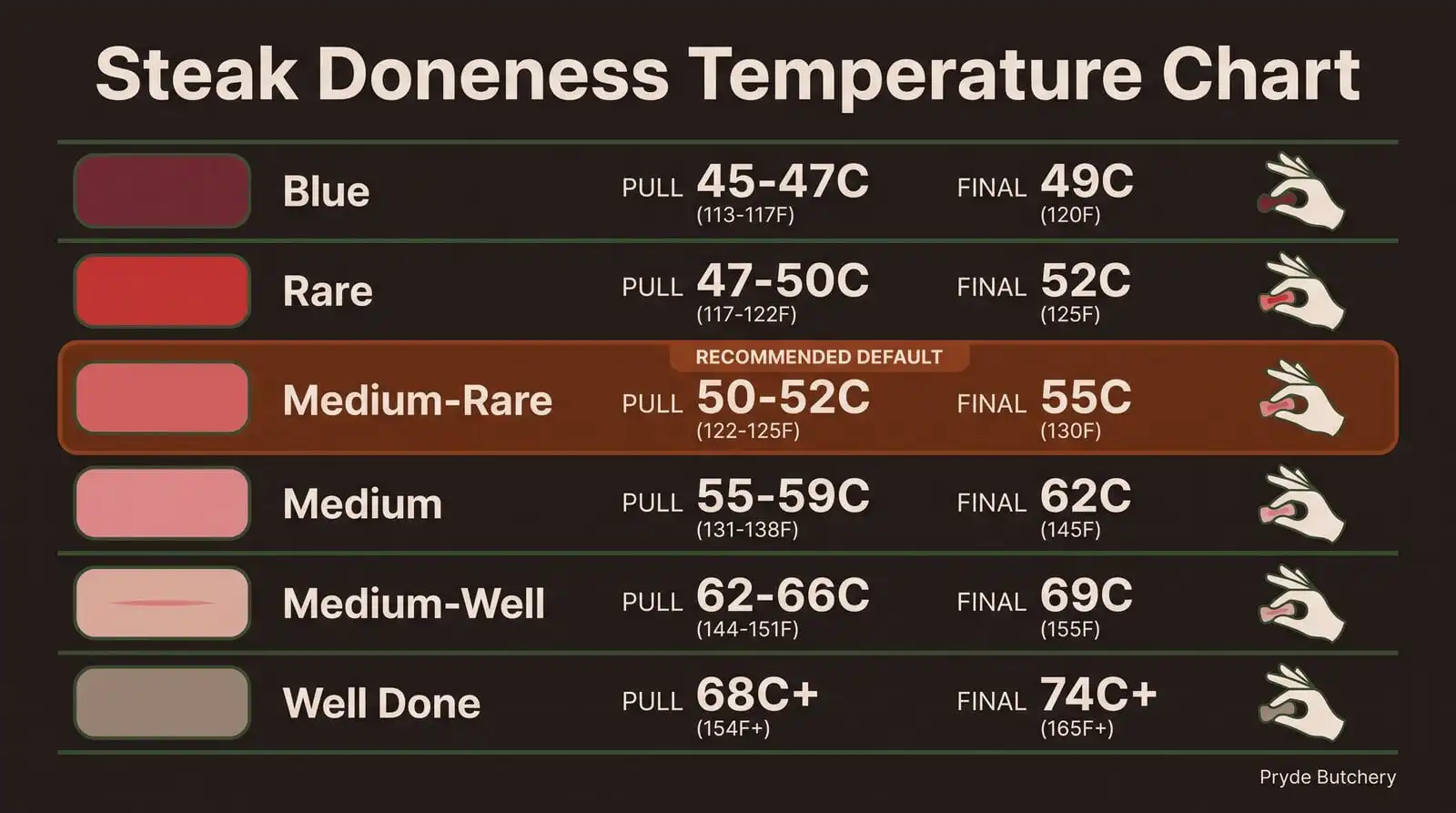
Here's the full reference, final temperature first, Celsius: Blue 49°C, Rare 52°C, Medium-Rare 55°C, Medium 62°C, Medium-Well 69°C, Well Done 74°C+. Pull each level 2–3°C before that number and let carry-over cooking finish the job during the rest — the complete pull-and-final breakdown is in the table below.
This chart is the page's main reason for existing. Every section that follows — pull temperature, food safety, the finger test, cook times, cut-specific adjustments — refers back to it rather than restating numbers, so keep it open in another tab while you read.
| Doneness | Pull Temp (°C) | Final Temp (°C, after rest) | °F (final) | Colour | Finger Test |
|---|---|---|---|---|---|
| Blue / Bleu | 45–47°C | 49°C | 120°F | Deep purple-red, cool centre | Relaxed hand |
| Rare | 47–50°C | 52°C | 125°F | Red centre, warm throughout | Thumb to index |
| Medium-Rare | 50–52°C | 55°C | 130°F | Pink centre, red fading at edges | Thumb to middle |
| Medium | 55–59°C | 62°C | 145°F | Pink throughout, no red | Thumb to ring |
| Medium-Well | 62–66°C | 69°C | 155°F | Slight pink in centre only | Thumb to pinky |
| Well Done | 68°C+ | 74°C+ | 165°F+ | Brown/grey throughout | Clenched fist |
Compiled from USDA FSIS, FSANZ, and ThermoWorks carry-over guidance — see sources cited throughout this guide.
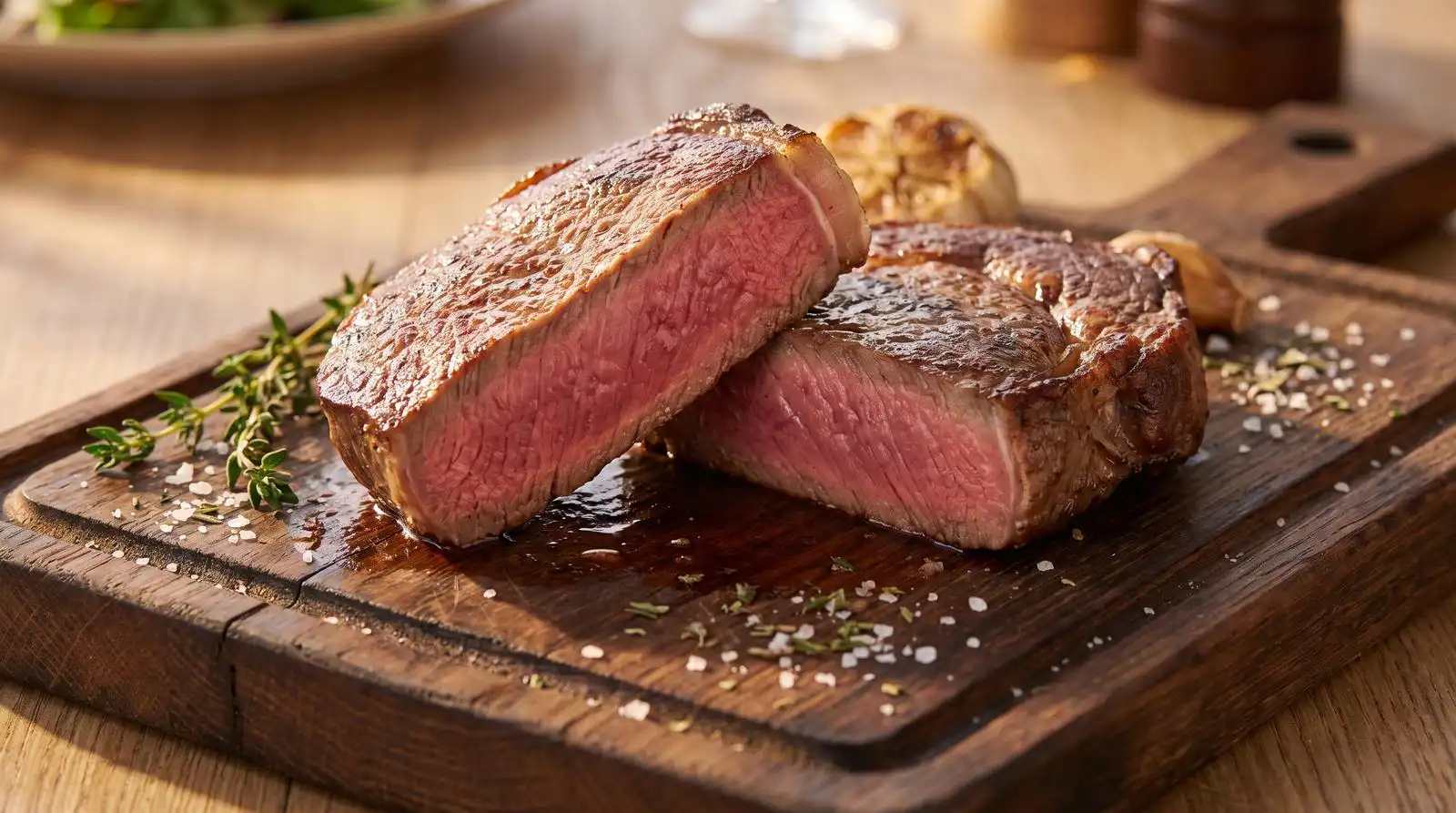
Hold that chart up against a well-marbled scotch fillet and you'll start to see why the medium-rare row is the default most Australian cooks reach for — though as H2 6 below explains, it isn't the only right answer for every cut.
Pull your steak 2–3°C (3–6°F) below your target — carry-over cooking finishes the job while it rests (ThermoWorks). Any doneness chart that lists only a final number without a pull temperature is setting you up to overshoot, which is exactly why the pull-temp column in the chart above matters more than the final-temp column.
Carry-over cooking happens because heat doesn't stop moving the instant a steak leaves the pan. The outer layers stay hotter than the core, and that residual heat keeps travelling inward toward the cooler centre for several minutes after direct heat stops.
For a standard grilled or pan-seared steak, that residual heat typically adds another 2–3°C (3–6°F) at the thermal centre (ThermoWorks). Thicker cuts, or anything cooked hot and fast, can carry over more — ThermoWorks recommends pulling 5–7°F (roughly 3–4°C) early under high-heat grilling specifically because the swing is bigger there than on a gentler pan-fry.
So why do so many published charts skip the pull number entirely? Probably because a single "final" figure is simpler to print, even though it's the number that gets people into trouble. Pull at the target instead of before it and you'll overshoot by several degrees — often exactly the gap between medium-rare and medium. A 5–10 minute rest gives carry-over time to finish without the steak going cold on the plate.
Sous vide is the one method where none of this applies. The water bath's set temperature is the final temperature, full stop — there's no carry-over because the steak never gets hotter than the water surrounding it. If you're cooking a thick cut that way, simply set the bath to your target final number from the chart above and sear hard afterward for colour — no pull-and-rest maths required.
Yes — whole-muscle beef is safe at medium-rare provided the outside is properly seared. The USDA sets 62.8°C (145°F) as its whole-cut safety benchmark, held through a minimum 3-minute rest (USDA FSIS); Australia's FSANZ takes a genuinely different approach, and that difference is worth understanding before you trust any single number online.
Whole muscle differs from mince because of where bacteria actually live. On an intact steak, harmful bacteria sit on the surface — they can't get inside unless the meat's been pierced, tenderised, or injected. Searing that surface to a high temperature kills them, which is why the interior can stay rarer than a food-safety chart for mince would ever allow.
Australia's FSANZ doesn't publish one blanket number for steaks the way the USDA does. Its general consumer guidance is to cook food to 70°C in the centre when a number's needed, and minced or rolled meat specifically must reach 75°C throughout, because processing spreads bacteria from the surface into the middle (FSANZ). For intact whole cuts, its position is simpler: cook to preference, rare included, as long as the outside has been properly heated.
Put plainly: the US gives home cooks one number to hit. Australia gives regulators a searing standard to hit, and leaves a home cook's rare steak to common sense and a hot pan. Neither approach is wrong — they're solving the same problem from different ends, and no competing steak chart currently explains both sides.
Practical implication: none of this means cook a steak to 62.8°C or 65°C for flavour. These are food-safety floors for situations where searing alone isn't guaranteed to be enough — mince, tenderised cuts, needle-injected product. A well-seared, whole-muscle steak pulled at 50°C for medium-rare sits comfortably inside both systems' actual intent.
Overkill for a Tuesday-night steak? Not if you've ever wondered why a butcher shrugs at rare eye fillet but insists mince goes well done — now you know the actual rule behind that habit, not just the habit itself.
The finger test works once you've practiced it a few times: compare the fleshy pad at the base of your thumb at different finger positions. It's less precise than a thermometer, but only 27% of surveyed US adults say they use one when cooking meat at all (Annenberg Public Policy Center, 2024). Match what you feel against the "Finger Test" column in the chart above.
Here's how it works: relax your hand completely and press the fleshy base of your thumb — that softness is roughly rare. Touch your thumb to your index finger and press the same spot again; the firmer feel is medium-rare. Move through middle finger (medium), ring finger (medium-well), and pinky (well done), pressing the thumb pad each time and comparing.
A quick backup for when you're between finger positions: press your own cheek for something close to rare, your chin for medium, your forehead for well done. It's rougher than the finger test, but it works in a pinch when your hands are covered in marinade.
Beyond touch, watch the visual cues too — juice colour beading on the surface, how much the steak resists a finger press, and the colour right at a cut edge. None of these replace a thermometer on their own, but stacked together they're a genuinely reasonable read.
Why bother learning touch at all when an instant-read thermometer costs $15–20? Because most people don't reach for one. Only 27% of US adults surveyed by the Annenberg Public Policy Center in 2024 said they use a thermometer when cooking meat, poultry, or fish, and 29% said they never do at all (CIDRAP). If that's you, the finger test is worth learning properly rather than dismissing.
None of that means skip the thermometer entirely. An instant-read one is still the accurate backup — cheap, fast, and worth owning even for the nights you end up relying on touch instead.

A standard 2.5cm steak needs roughly 2–3 minutes per side for medium-rare over high heat, following the rough rule of about 1 minute per side per centimetre of thickness. Thicker cuts — 3cm and up — need a reverse sear or pan-to-oven finish, or the outside burns before the centre catches up.
| Thickness | Medium-Rare (per side) | Method |
|---|---|---|
| 1.5cm | ~1.5 min | Pan-fry only |
| 2.5cm (standard) | ~2–3 min | Pan-fry or reverse sear |
| 4cm (thick cut) | Reverse sear: ~25–30 min oven + 1 min sear | Reverse sear or pan-to-oven |
| 5cm+ (tomahawk) | Reverse sear: ~35–45 min oven + 2 min sear | Reverse sear recommended |
Can you skip the reverse sear on a thick cut if you're short on time? You can, but expect a wide grey band under the crust and a smaller pink centre than the chart above promises — the reverse sear exists specifically to avoid that trade-off. It flips the usual order: the steak goes into a low oven (120°C) until it's 3–5°C below your target, then gets a hard, fast sear in a screaming-hot pan just for the crust. It's slower than a straight pan-fry, but it's the only reliable way to cook a thick cut evenly from edge to centre.
The single most important rule for anything 3cm or thicker: don't put it straight into a hot pan. Direct high heat chars the surface long before the centre reaches temperature, leaving a thick grey band around a small pink centre — the opposite of what the chart above is asking for. Stick to the reverse-sear sequence outlined above — low oven until 3–5°C under target, then a hard, fast sear — and the thickness stops being a problem.
Yes — a well-marbled scotch fillet at medium (55–62°C, pull to final) can taste better than the same cut at medium-rare, because the extra heat renders intramuscular fat. A lean eye fillet, by contrast, peaks at medium-rare and turns dry past it. Use the chart above as your baseline, then adjust up or down a level for the cut in front of you.
Tender, lean cuts are the ones where medium-rare is the ceiling, not a suggestion. Eye fillet — also sold as tenderloin — and sirloin both carry minimal fat marbling, so cooking past medium-rare just dries them out without adding anything back. Target 52–55°C and stop there.
Well-marbled tender cuts behave differently. Scotch fillet (rib-eye) and rump can both handle medium — 55–62°C, pull to final — without drying out, because the extra heat renders intramuscular fat rather than just toughening the muscle fibres. A T-bone splits the difference: fillet on one side, sirloin on the other, so aim for the fillet side's limit and let the sirloin side ride a touch hotter.
Does that mean every tough cut should just be pushed to well done and left there? Not exactly — it means the whole doneness framework stops applying. Brisket, short ribs, and beef cheeks need 90°C+ and hours of slow, moist heat to break down collagen into gelatine, and a thermometer reading "well done" on a brisket doesn't mean what it means on a steak. Treat these as their own category, not an extension of the chart above.
| Cut | Best Doneness | Internal Temp |
|---|---|---|
| Eye Fillet / Tenderloin | Rare to Medium-Rare | 49–55°C |
| Sirloin / New York Steak | Medium-Rare | 52–55°C |
| Scotch Fillet / Rib-eye | Medium-Rare to Medium | 52–60°C |
| Rump | Medium-Rare | 52–55°C |
| T-Bone | Medium-Rare | 52–55°C |
| Brisket, Short Rib | Well Done (slow-cooked) | 90°C+ |
Medium-rare steak is 52–55°C (125–130°F) at the final internal temperature. Pull it at 50–52°C and let carry-over cooking bring it the rest of the way during a 5–10 minute rest (ThermoWorks) — see the full chart at the top of this guide for all six doneness levels at once.
Yes, for whole-muscle beef that's been properly seared. Bacteria live on the surface, and searing kills it — the USDA sets 62.8°C (145°F) as its benchmark (USDA FSIS), while Australia's AS 4696:2007 standard instead requires a seared surface holding 65°C for 10 minutes. Mince is different — FSANZ requires it reach 75°C throughout.
Roughly 2–3°C (3–6°F) for a standard grilled or pan-seared steak, more for thick cuts cooked hot and fast (ThermoWorks). Pull 5–7°F (about 3–4°C) below your target under high heat, and give the steak 5–10 minutes to rest before cutting into it.
Compare the fleshy base of your thumb at different finger positions: relaxed for rare, thumb-to-index for medium-rare, through to thumb-to-pinky for well done. It takes practice to calibrate against your own hand, but it's the backup most cooks actually use — only 27% report reaching for a thermometer at all (Annenberg Public Policy Center, 2024).
Yes. Well-marbled cuts like scotch fillet suit medium because the extra heat renders fat without toughening the meat; lean cuts like eye fillet peak at medium-rare and dry out past it. Use the chart above as the baseline, then adjust a level for the cut in your pan.
Screenshot the chart above or bookmark this page. It's built to be a permanent kitchen reference — something you check every time you cook a steak, not a once-off read — so it's worth having on hand the next time the pan's smoking and the doubt creeps back in.
Every cut in this chart is available cut-to-order at Pryde Butchery — shop online and it arrives ready for whichever doneness you're aiming for.
