
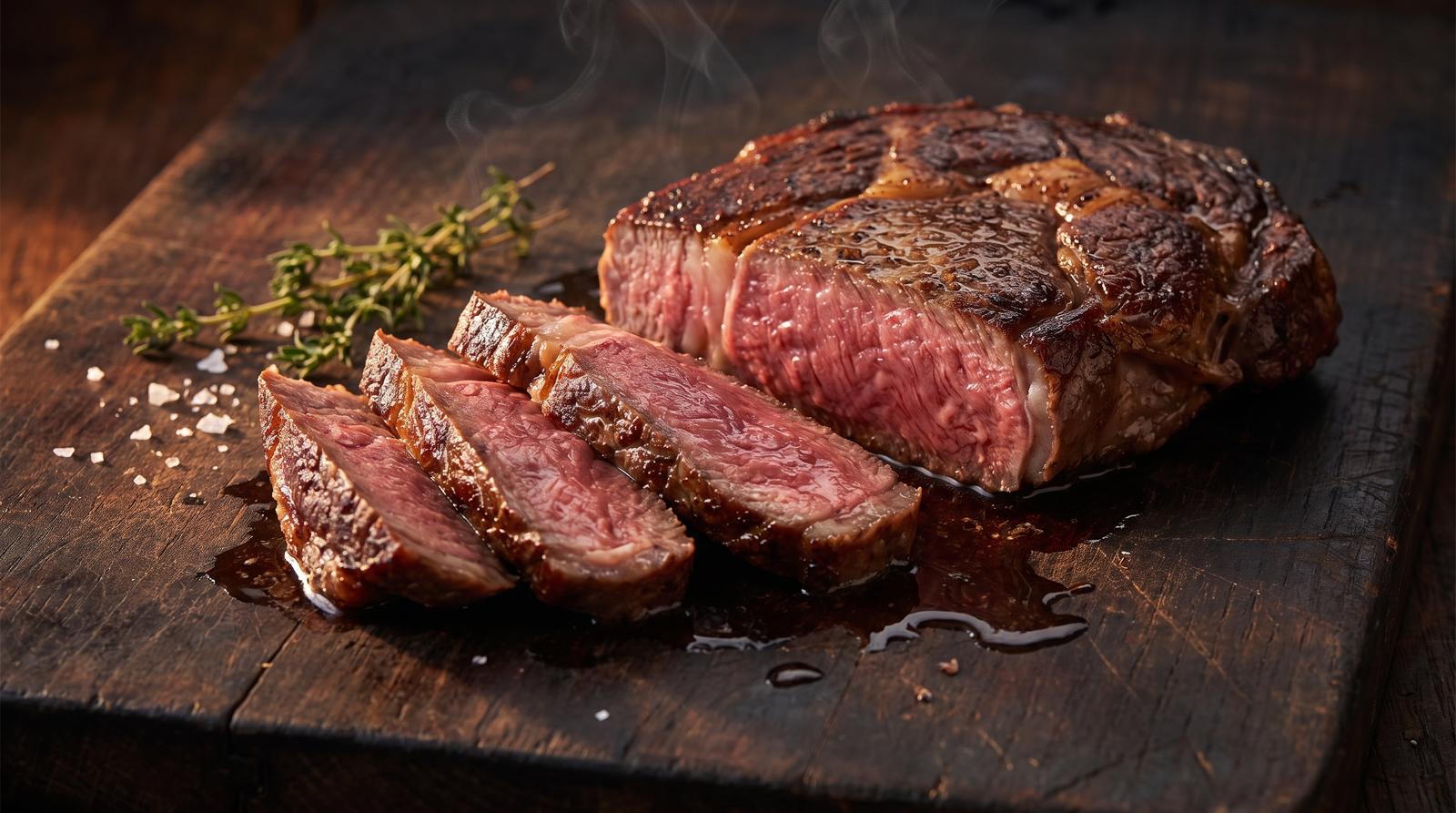
Walk into any butcher or supermarket in Australia, and you'll see the word "Angus" on at least half the beef in the cabinet. It's the most common label in the beef fridge, but what does it actually mean? Angus genetics now influence 53% of Australia's national female beef herd (Angus Australia, 2024), making it genuinely the backbone of Australian beef production.
But widespread doesn't mean well understood. In fact, much of the "Angus" on supermarket packs refers to beef with as little as 50% breed content, a threshold that was lowered by industry regulators in 2024. If you're buying Angus beef and expecting a specific eating experience, knowing what the label actually tells you is worth a few minutes.
Angus is Australia's dominant beef breed, with genetics influencing over half the national female herd (Angus Australia, 2024). The breed's predisposition to intramuscular marbling drives its reputation for flavour and tenderness. When buying, an MSA grade on the label tells you far more about eating quality than "Angus" written on the pack.
Angus beef comes from Aberdeen Angus cattle, a breed that originated in Aberdeenshire and Angus counties in northeast Scotland in the early 1800s. The breed is naturally polled (hornless), typically black-coated (some are red Angus), and known for a compact, efficient frame. Scottish farmers noticed early that these cattle finished quickly and produced consistently high-quality meat.
Angus cattle arrived in Australia in the 1800s and proved well-suited to local conditions: tolerant of cold climates, good converters of pasture to muscle, and reliable producers. Specifically, by 2022, Angus accounted for 36.65% of all national seedstock registrations, more than double the second-place Brahman at 13.19% (Beef Central, 2022). That dominance has only grown: registered Angus bull head grew 57.4% to 144,073 in 2024, the largest single-year increase of any breed in the country.
Angus cattle carry a genetic predisposition for intramuscular fat, the fat deposited within the muscle fibre itself, not around it. Marbling is the visible result: the flecks and streaks of fat running through a cut. In particular, marbling is one of the strongest predictors of flavour, tenderness, and juiciness in cooked beef.
Meat Standards Australia's eating quality research is built on more than 1.8 million consumer taste tests by 250,000+ consumers across 13 countries (Meat & Livestock Australia, ongoing). Notably, the data confirms that marbling drives eating quality, though it accounts for only 10–20% of total variation, which means breed alone doesn't guarantee a great result on its own. Feed programme, age, stress at slaughter, and post-processing all contribute.
What Angus does well is consistency. Given a known finishing programme and feed quality, Angus cattle produce predictable marble scores across a mob. In particular, that predictability matters both when a butcher is selecting stock and when a customer wants reliable results from the same cut week to week.
MSA is short for Meat Standards Australia, the grading system you want to understand before buying beef in Australia. Specifically, in 2023–24, MSA graded a record 3.64 million head (50.4% of all adult cattle slaughtered nationally), achieving an average MSA Index of 58.36, a new benchmark (Meat & Livestock Australia, 2024).
The system uses 14 carcass traits per carcase (including marbling, ossification, pH, and fat cover) to predict eating quality outcomes for each cut and cooking method. Importantly, the grade reflects the specific animal and the specific cut, not just the breed.
| MSA Star Rating | Eating Quality Band | What to Expect |
|---|---|---|
| 3-star | Good everyday | Reliable, satisfying results for typical midweek cooking |
| 4-star | Better than everyday | Noticeably more tender and flavourful; worth the upgrade |
| 5-star | Premium quality | Top-tier eating experience, best reserved for special occasions |
What this means practically: an MSA-graded scotch fillet with a marble score of 3–4 is a far more reliable buying signal than the word "Angus" alone. In other words, the label tells you the breed (to a minimum threshold), while the MSA grade tells you what will actually happen when you cook it.
That financial signal matters too. MSA delivered a record $326 million in additional farmgate returns to producers in 2023–24, with retail butcher premiums averaging $2.55 per kg above ungraded beef (Meat & Livestock Australia, 2024). That premium exists because consumers, given blind eating quality tests, consistently choose MSA-graded beef.
Meat Standards Australia graded a record 3.64 million head of cattle in 2023–24, representing 50.4% of all adult cattle slaughtered in Australia. The system is built on more than 1.8 million consumer taste tests and uses 14 carcass traits per carcase to predict eating quality by cut and cooking method (Meat & Livestock Australia, 2024). MSA-graded beef delivered $326 million in additional farmgate value that year.
Read the full explainer on MSA marble scores and eating quality grades.
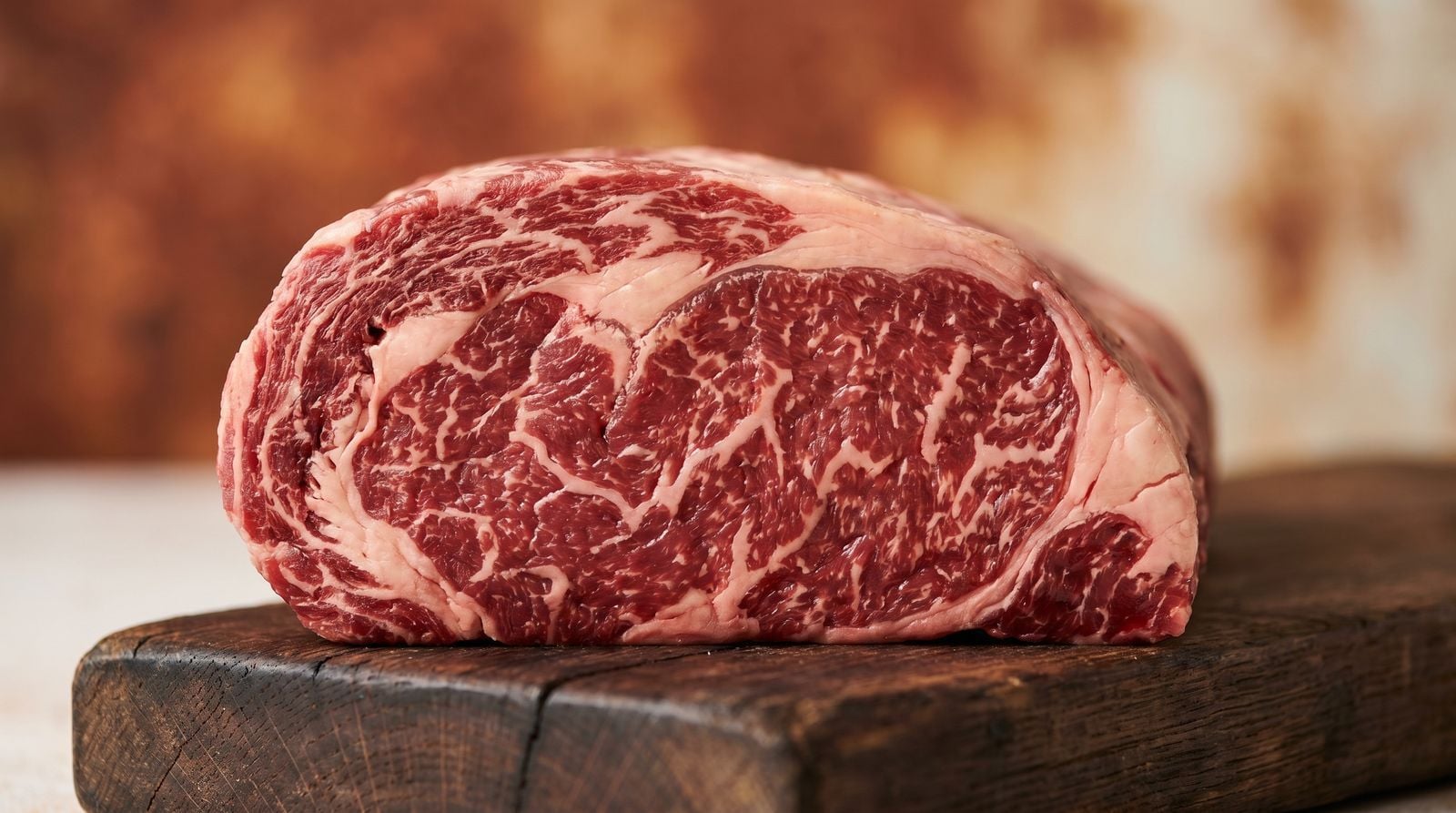
AUS-MEAT is the independent body that sets and audits Australia's beef grading and marbling standards. Both breeds are known for marbling, but they sit in very different places on its scale. Standard grassfed beef typically falls at MB0–2 on the AUS-MEAT marble scale. Well-finished Angus reaches MB3–5. F1 Wagyu × Angus crosses (common in Australia) commonly achieve MB5–6. Fullblood Australian Wagyu regularly scores MB7–9+ (Australian Wagyu Association, 2024).
| Beef Type | AUS-MEAT Marble Score |
|---|---|
| Standard grassfed | MB 0–2 |
| Angus (grain-finished) | MB 3–5 |
| F1 Wagyu × Angus | MB 5–6 |
| Fullblood Wagyu | MB 7–9+ |
The genetics behind that gap are significant. Wagyu cattle carry specific variants of the FABP4 and SCD1 genes that dramatically increase intramuscular lipogenesis, causing fat to accumulate within muscle tissue at rates no other breed approaches. In contrast, Angus marbles more consistently than most British and European breeds, but it has a lower ceiling.
That said, an MB4 Angus scotch fillet from a quality butcher is exceptional eating. Wagyu's higher marble scores bring a rich, buttery flavour that works beautifully in smaller portions (150–200g). Past MB7–8, the richness can become overwhelming at normal steak portion sizes. Angus gives you more versatility across cuts, portion sizes, and cooking methods, at a significantly lower price point.
Crossbred F1 Wagyu × Angus occupies the middle ground. It's common in Australia because Angus cows are reliable for crossbreeding, and the resulting cattle often hit MB5–6 with grain-finishing. Notably, whether it's "worth it" over a premium Angus depends on how much you value the additional marbling richness versus the cost difference.
Australian fullblood Wagyu regularly scores above MB7 on the AUS-MEAT marble scale, while premium grain-finished Angus typically reaches MB3–5. F1 Wagyu × Angus crosses, widely produced in Australia, commonly achieve MB5–6 (Australian Wagyu Association, 2024). The genetic gap comes down to specific gene variants in Wagyu cattle that drive intramuscular fat accumulation at rates no other breed reaches.
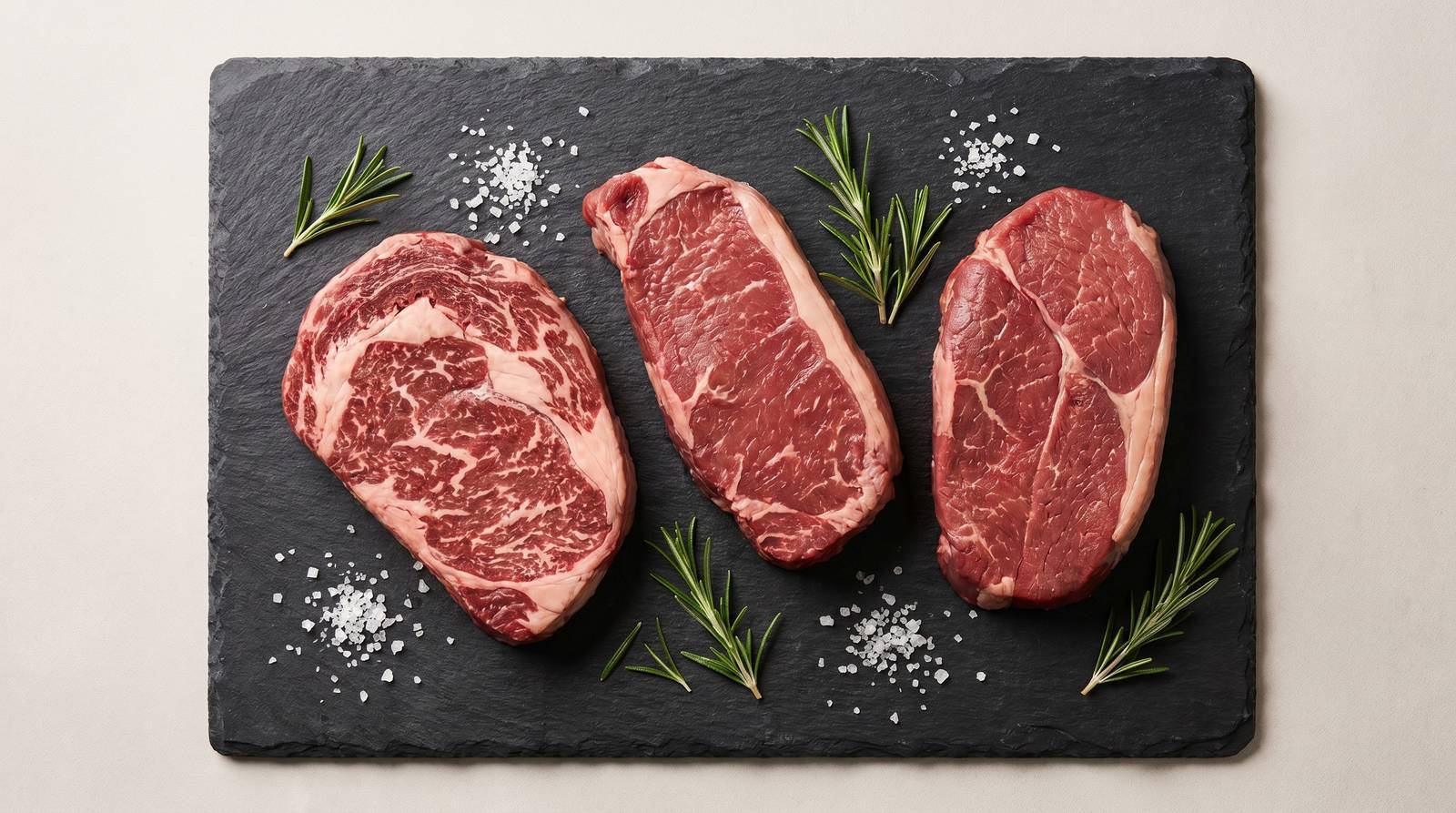
Angus quality isn't uniform across every cut. Specifically, knowing where the breed's strengths actually show up helps you make better buying decisions.
This is where Angus shines. For instance, the rib primal carries the highest intramuscular fat content of any primal cut, and Angus genetics mean that marbling distributes evenly through the longissimus dorsi muscle. A well-finished Angus scotch fillet needs little more than salt, a ripping hot pan, and a proper rest. See our scotch fillet vs ribeye guide for the Australian naming breakdown.
A clean balance of lean muscle and fat cap. The sirloin rewards breed quality because the leaner muscle needs marbling to stay juicy over heat; without it, the cut dries out quickly past medium-rare. In contrast to the scotch fillet, Angus delivers well here: less rich, but with pronounced, clean beef flavour. Full naming breakdown here: what is sirloin steak in Australia.
Where breed quality shows clearly in grain-finished animals. The rump primal contains several distinct muscles, some lean and some moderately marbled. In particular, Angus genetics help in the more marbled sections, especially the rump cap (picanha), which benefits most from good marbling distribution.
For slow-cook applications, Angus fat content works strongly in your favour. Both cuts carry significant connective tissue that breaks down over long, low cooking. As a result, the intramuscular fat keeps the meat moist through that process. A grass-fed Angus brisket slow-cooked for 8–10 hours is one of the breed's best expressions.
The leanest prime cut. Breed matters less here because the tenderloin muscle does very little work and carries minimal fat regardless of genetics. Angus eye fillet is excellent; in other words, you're paying for tenderness from muscular inactivity, not breed-specific marbling. Worth buying; don't expect the richness of a scotch fillet.
The word "Angus" on a supermarket pack now legally applies to beef with as little as 50% breed content. That's not necessarily bad beef; nonetheless, it's not the same guarantee as sourcing from producers who track breed composition, finishing programmes, and MSA grades.
A good butcher should be able to tell you where the animal came from, how it was finished (grass or grain, and for how long), and what the marble score is. In fact, if those answers aren't available, that's a sourcing signal in itself.
The marbling in good Angus beef is its greatest asset, and the easiest way to waste it is overcooking. Intramuscular fat renders between 54°C and 74°C. Push beef much past medium (~65°C internal) and that fat has liquefied and run out of the muscle. As a result, what's left is drier, tougher, and lacks the flavour the marbling was supposed to deliver.
For steaks:
- Medium-rare (54–57°C) maximises juiciness and the full flavour contribution from fat
- Medium (60–63°C) is the practical ceiling for most Angus cuts before noticeable dryness
- Rest is non-negotiable: 5 minutes for a scotch fillet, 8–10 for larger cuts
For slow-cook cuts (chuck, brisket, short rib):
- Long, low, and covered: 130–150°C oven or similar, 8–12 hours
- Collagen conversion to gelatine happens gradually; rushing it produces tough, dry results
- Internal temperature matters less than sustained time at temperature
For the science behind that rest, see does resting meat actually matter.
We source grass-fed Angus because the combination of breed genetics and pasture finishing produces beef with clean, complex flavour and reliable eating quality. Specifically, grass-fed animals develop more slowly and are leaner than grain-finished animals, with a different fat profile (higher omega-3 fatty acids and conjugated linoleic acid) and a more pronounced grass-and-mineral character in the meat.
The honest trade-off: grass-fed Angus typically carries less intramuscular fat than grain-finished Angus of the same age. What you get instead is a leaner product with more flavour depth in the muscle itself. Notably, for many cuts (brisket, rump, chuck, short rib), that's a genuine quality advantage, not a compromise.
Buying from a supermarket pack labelled "Angus" gets you beef that meets a labelling standard. In contrast, buying from a butcher who sources by breed, finish, and provenance gets you something more specific. That specificity (knowing what the animal ate, where it came from, how it was processed) is what drives consistent eating results. Read more on the benefits of grass-fed beef for flavour and nutrition.
No. "Angus" is a breed label, not a quality grade. In Australia, beef can legally be sold as "Angus" with as little as 50% breed content (Beef Central, 2024). In other words, the MSA grade, marble score, and finishing programme are more reliable quality indicators than the breed name on the pack.
Grain-finished Angus typically reaches higher marble scores (MB3–5) than grass-fed of the same age. In contrast, grass-fed Angus is leaner, with a more complex flavour profile and a better ratio of omega-3 fatty acids to saturated fat. Both produce excellent results; the right choice depends on the cut and what you're cooking. See the benefits of grass-fed beef for the full nutrition and flavour comparison.
Angus cattle have a genetic predisposition to intramuscular marbling that most other breeds don't share to the same degree. Over half of Australia's female beef herd now carries Angus genetics (Angus Australia, 2024); as a result, much supermarket beef already has some Angus influence. High-content, well-finished Angus from a known source is a step above that baseline.
For everyday cooking, MB2–3 delivers noticeably better flavour and juiciness than unmarked beef. For example, MB4–5 in a scotch fillet or sirloin is exceptional, approaching the lower end of Wagyu-territory richness at a fraction of the price. MSA uses a different scale (100–1,190), but most quality butchers can translate it for you. See meat marble scores and why they matter for the full explanation.
Yes, and it's one of the best applications of the breed. Notably, the intramuscular fat in Angus holds well over extended dry-ageing periods (21–45 days), concentrating flavour as surface moisture evaporates. The fat content also protects the interior from drying out during the process. Grain-finished Angus with higher marbling responds especially well to extended ageing. Read our full guide on what is dry-aged beef.
Angus is Australia's dominant beef breed for good reason: the genetics produce consistent, well-marbled eating results across a wide range of cuts and cooking methods. But the word "Angus" on a pack is a starting point, not a guarantee. The MSA grade, the marble score, the finishing programme, and the actual breed content behind the label are what determine what ends up on your plate.
Grass-fed Angus and grain-finished Angus offer genuinely different experiences: leaner and more complex in flavour versus richer and more deeply marbled. Neither is universally better. They suit different cuts and different cooking approaches.
If eating quality matters to you, look past the label. Ask where the animal came from and how it was finished. That question (and whether your butcher can answer it) is the most reliable quality filter available.
This guide is reviewed by the Pryde Butchery team and updated as grading standards change. Have a sourcing question? Get in touch or read more about Pryde Butchery.
Breed and grading:
- Meat Marble Scores and Why They Matter
- The Benefits of Grass-Fed Beef
Cuts:
- Scotch Fillet vs Ribeye: What's the Difference?
- What Is Sirloin Steak in Australia?
Cooking:
- Resting Meat: Does It Actually Matter?
- What Is Dry-Aged Beef?
