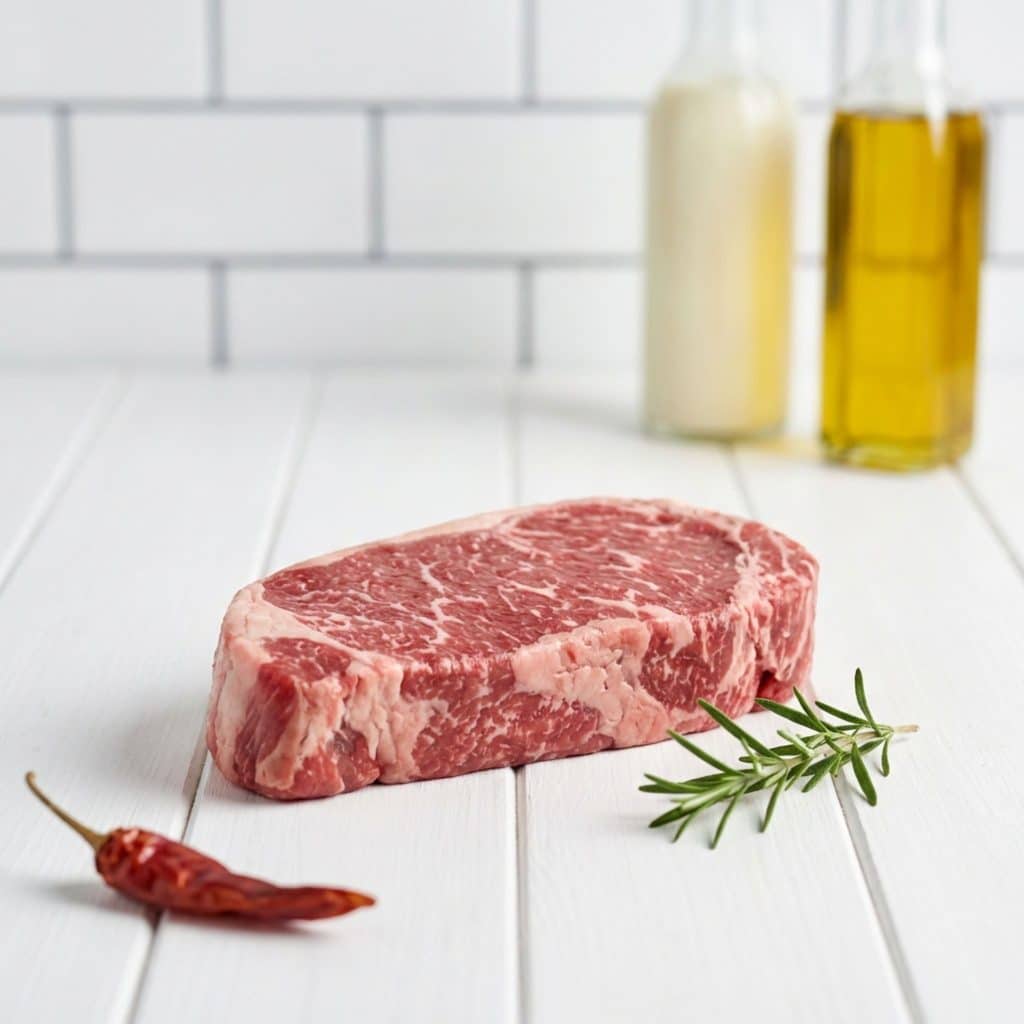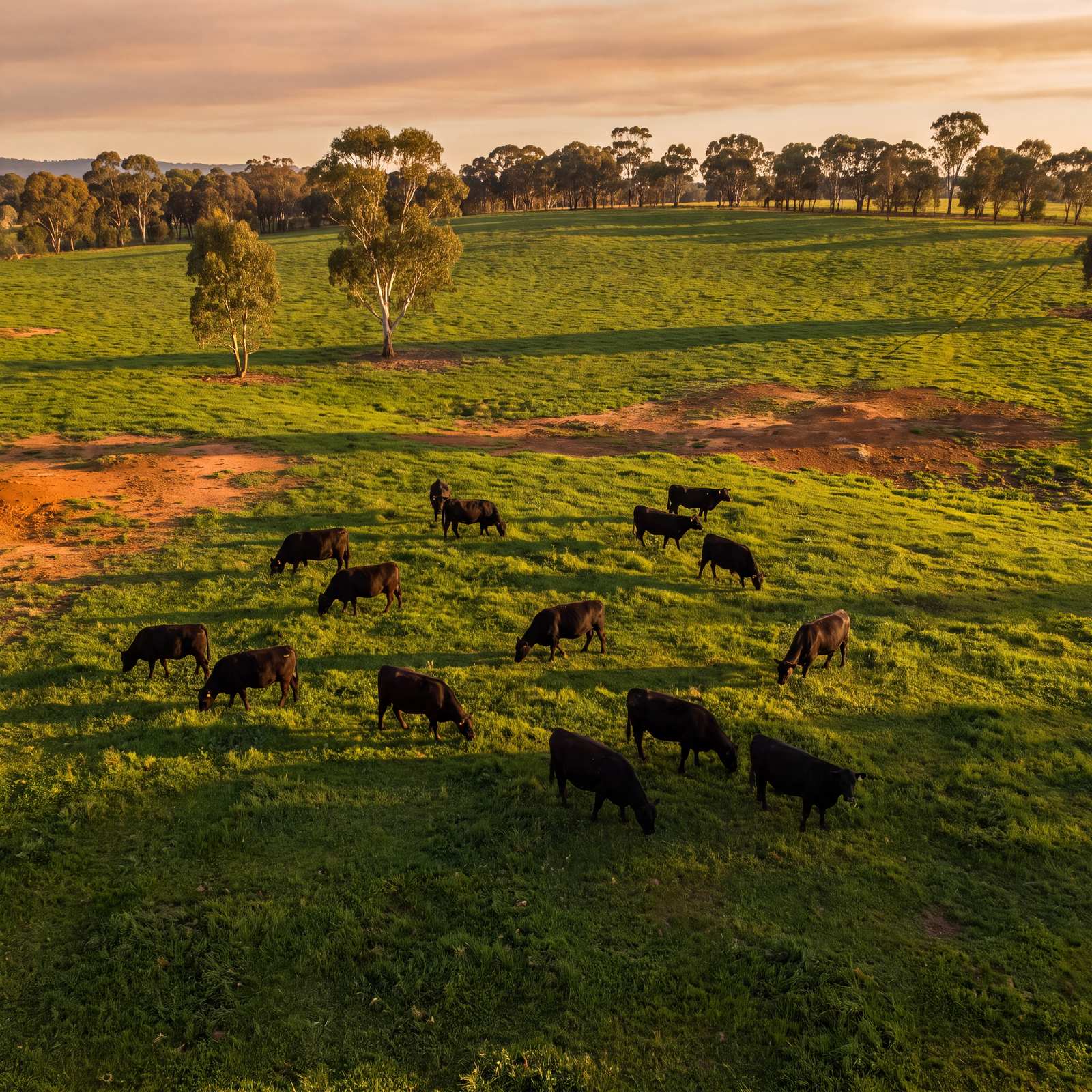
"Is your beef grass-fed?" It's one of the most common questions we hear at the counter, and the honest answer is rarely a simple yes or no. Grass-fed, grass-finished, grain-fed, grain-finished — the terms sound interchangeable, but they describe different diets, different timelines, and, depending on which country you're in, very different labelling rules.
Australia and the United States sit at opposite ends of this spectrum. Australian cattle start life on pasture almost everywhere, with grain used mostly as a short finishing step. American cattle typically spend months on a grain-based feedlot ration for the bulk of their growth. So which is it — grass or grain? The honest answer: it depends which side of the Pacific you're shopping on.
Most Australian beef starts life on pasture and moves to grain for just 50-120 days to finish (MLA), while US beef typically spends 4-6 months in a feedlot after an early grazing period (Beef Research). Grain feeding is the US default; grass-fed is the smaller, faster-growing niche, with 2024 category sales up 29.8% (FoodNavigator).
Australian cattle graze on pasture almost everywhere as a starting point, moving to grain for a short finishing window of around 50-120 days on average (Australian Good Meat/MLA). In the US, cattle typically transition to a grain ration earlier and remain on it for the bulk of their growth — a 4-6-month feedlot stint is standard (Beef Research).
That grain-finishing window isn't just Australia having grass to spare. Some regions don't grow enough pasture year-round to carry cattle right through to market weight, so a grain ration bridges the seasonal gap. Other producers deliberately finish on grain, chasing a marbling target that a specific buyer or export market wants. It's a mix of necessity and choice, not simply grass being so abundant that grain becomes optional.
The US works the other way around. Grain is comparatively cheap and abundant across its growing regions, so feedlot finishing became the default decades ago. Grass-fed beef never disappeared, but it stayed a smaller share of the market — filled largely by producers marketing directly to shoppers who want a documented, pasture-only diet.
That niche is growing fast, though. US grass-fed meat category sales rose 29.8% in dollars and 34.9% in pounds for the year ending December 29, 2024, comfortably outpacing organic meat's 14.3% growth and the 6.7% growth of total fresh meat sales over the same period (FoodNavigator, 2025, citing Circana/FMI data). Is grass-fed about to overtake grain-fed in the US any time soon? Not even close — but the growth curve says demand is shifting.
Grass fed means an animal ate only pasture, forage, or conserved fodder like hay for its entire life, with no grain ration at any stage. Grain fed means the animal spent part of its life — usually a finishing period — on a grain ration in a feedlot. Grass finished and grain finished describe the same two systems, just naming the final stage before an animal is ready for market.
So why bother with four separate terms if two of them mean nearly the same thing? Mostly because a marketing team will lean on whichever phrase sounds better on a label, even when the underlying diet is identical.
| Term | In Australia | In the USA |
|---|---|---|
| Grass Fed / Pasture-fed | Legally defined under the ARC Framework; cattle eat only pasture, forage, or fodder — no grain at any life stage (AUS-MEAT). | No mandatory federal standard since 2016; a voluntary 2019 FSIS guideline expects 100% grass from weaning, with pasture access and no confinement — but it's self-declared (National Agricultural Law Center). |
| Grass Finished | Used largely as a synonym for grass fed — the "finishing" stage is simply the final months on pasture, not a feedlot. | Same practical meaning as grass fed; some producers use "finished" to stress the animal never entered a feedlot, even briefly. |
| Grain Fed | Cattle start on pasture, then move to an NFAS-accredited feedlot for a defined grain-ration period — 35 days minimum under the newest GFF category, up to 100+ days under GF (MLA). | Cattle typically move onto a grain-based feedlot ration for the bulk of their growth, commonly 4-6 months (120-190 days), with no equivalent legally defined day-count standard. |
| Grain Finished | The feedlot period itself — a 35 to 120+ day stretch when a grain ration is added, tracked and audited by AUS-MEAT. | The feedlot period itself — typically the final 4-6 months before market, but duration isn't nationally standardised or audited. |
Read the full nutritional case for grass-fed beef for a deeper look at the health angle.
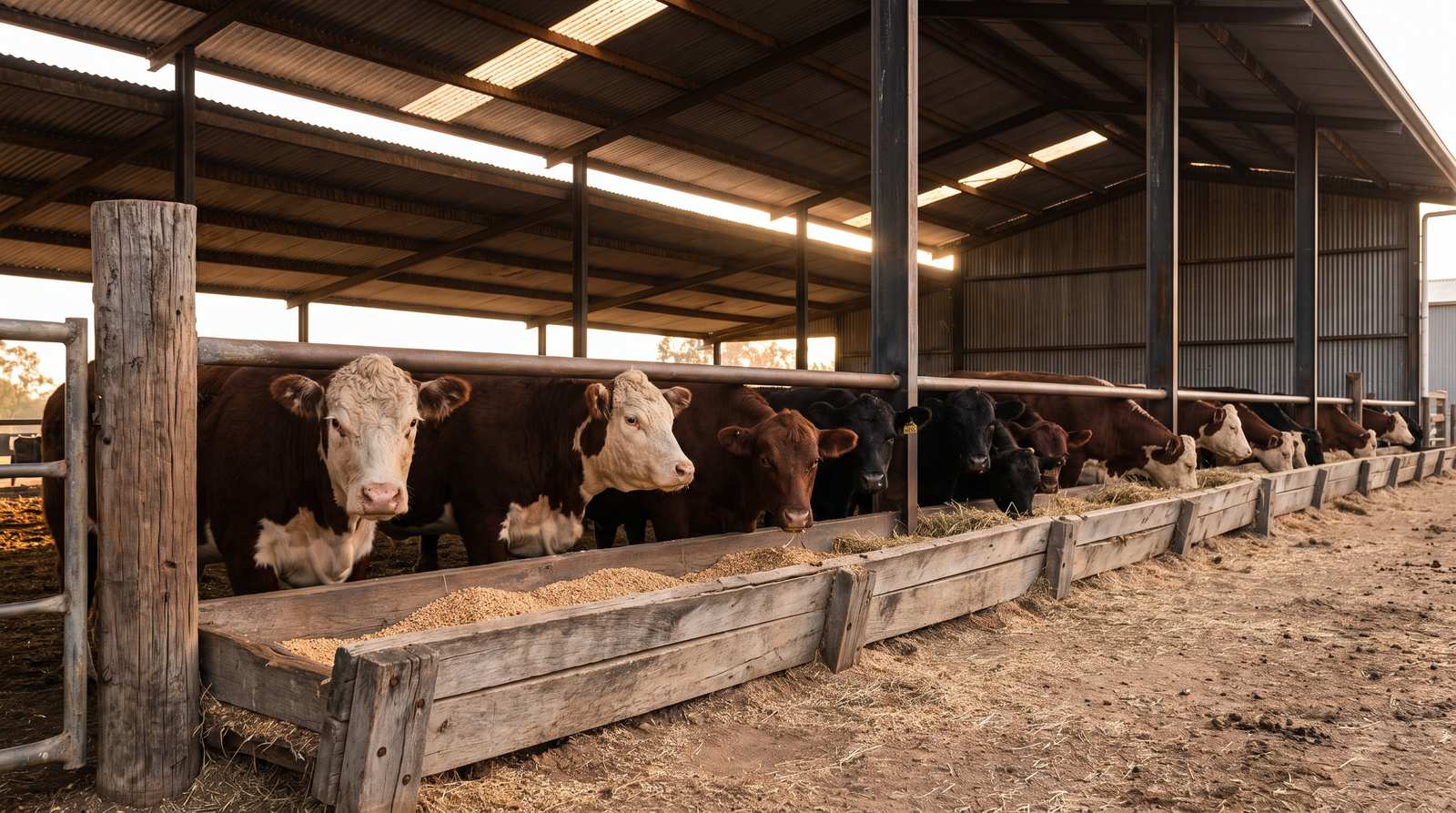
Australia audits grass-fed and grain-fed claims through AUS-MEAT's National Feedlot Accreditation Scheme (NFAS) and the broader ARC Framework, so a claim on Australian beef packaging usually traces back to an inspected standard. NFAS sets legally defined grain-fed categories: GF at 100+ days, GFYG at 60-70 days, and the newest GFF category at a 35-day minimum in an accredited feedlot (MLA).
AUS-MEAT is the independent body that audits every NFAS-accredited feedlot, checking that grain-ration days and pen conditions match what's printed on the pack. What actually stops a producer from just printing "grass fed" on a label in Australia? An outside auditor checking the paddock and feedlot records against the claim.
[INTERNAL-LINK: "Australia's other meat labelling laws" → hormone-free-chicken-lamb-australia (once published)]
PCAS, the Pasturefed Cattle Assurance System, operated as Australia's audited grass-fed certification for years, requiring annual third-party audits of member properties. It ceased on January 1, 2026, and was folded into the broader ARC Framework, which the industry body AMILSC approved back in 2017 to legally define the Grass Fed/Pasturefed, Grain Fed, and Fodder Fed categories in one place (AUS-MEAT).
The USDA withdrew its formal "Grass (Forage) Fed" marketing claim standard on January 12, 2016 (USDA). Since then, a "grass-fed" label on US beef has been a voluntary, self-certified claim, with no mandatory third-party audit standing behind it.
A 2019 FSIS guidance document filled part of that gap. It states a grass-fed claim should mean 100% grass and forage from weaning onward, with pasture access during the growing season and no confinement in a feedlot (National Agricultural Law Center). But it's guidance, not regulation — producers self-declare compliance, and nothing equivalent to Australia's AUS-MEAT inspections checks the paperwork.
Does that mean every US grass-fed claim is untrustworthy? Not at all. Plenty of producers run genuinely verifiable operations, and some seek out private certifications instead. It just means the US label itself doesn't carry a government-audited guarantee, as it does in Australia.
A 2026 peer-reviewed study of 337 ribeye samples from 108 producers found grass-fed beef's omega-6 to omega-3 ratio averaged 2.14 (±1.70), markedly lower than grain-fed beef's 8.28 (±3.92) — a statistically significant difference at P<0.001 (Journal of Animal Science, Oxford Academic, 2026).
Why does that ratio matter to an everyday shopper? Most nutrition guidance favours a lower omega-6-to-omega-3 ratio, since a diet high in omega-6 relative to omega-3 is linked to higher inflammatory markers. Grass and forage naturally carry more omega-3 fatty acids than grain, and that difference passes through into the meat itself.
Does a lower omega ratio automatically mean better flavour? Not necessarily. Grass-fed beef tends toward a leaner texture and a more mineral- and grassy-tasting profile; grain-fed beef tends to be richer and more consistently marbled. Nutrition and flavour pull in slightly different directions, and the right pick depends on what you value more.
For more on how marbling affects cut selection, see Scotch Fillet vs Ribeye: Same Cut, Different Names.
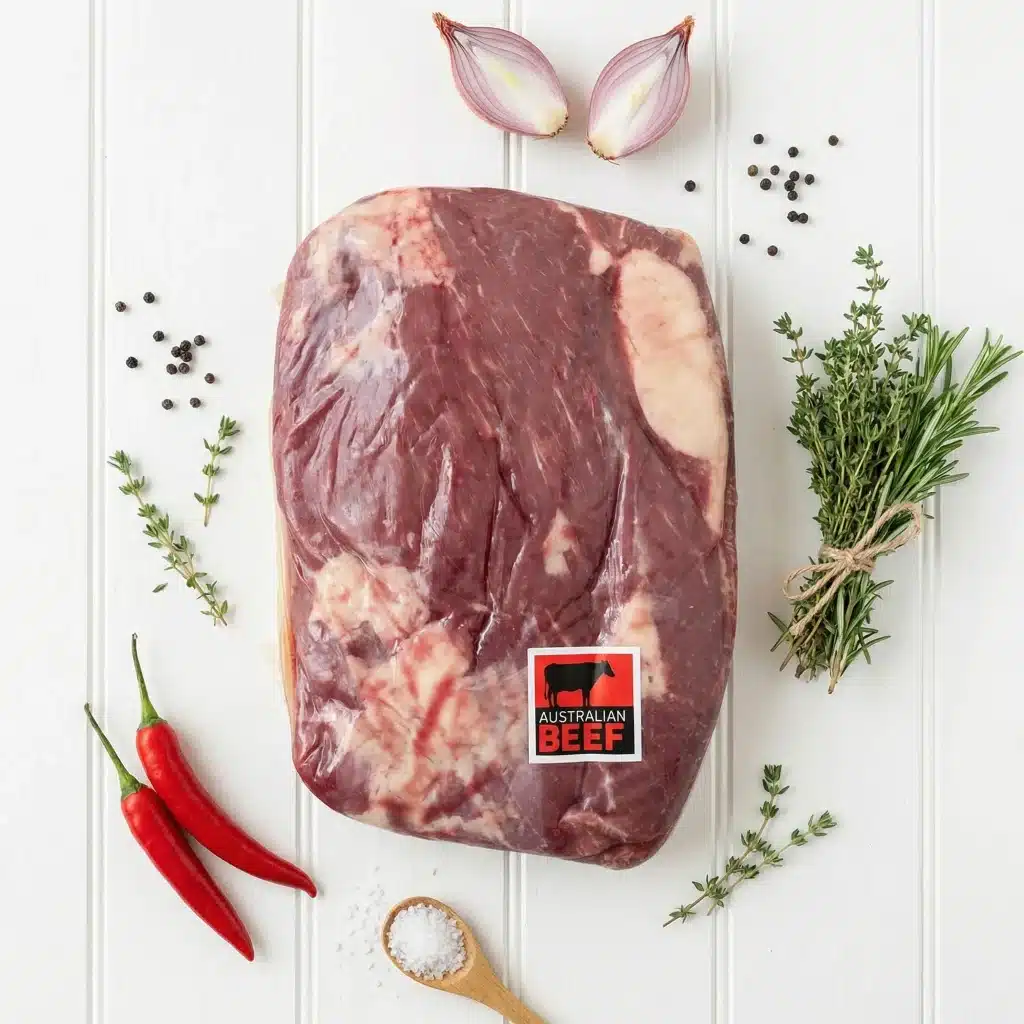
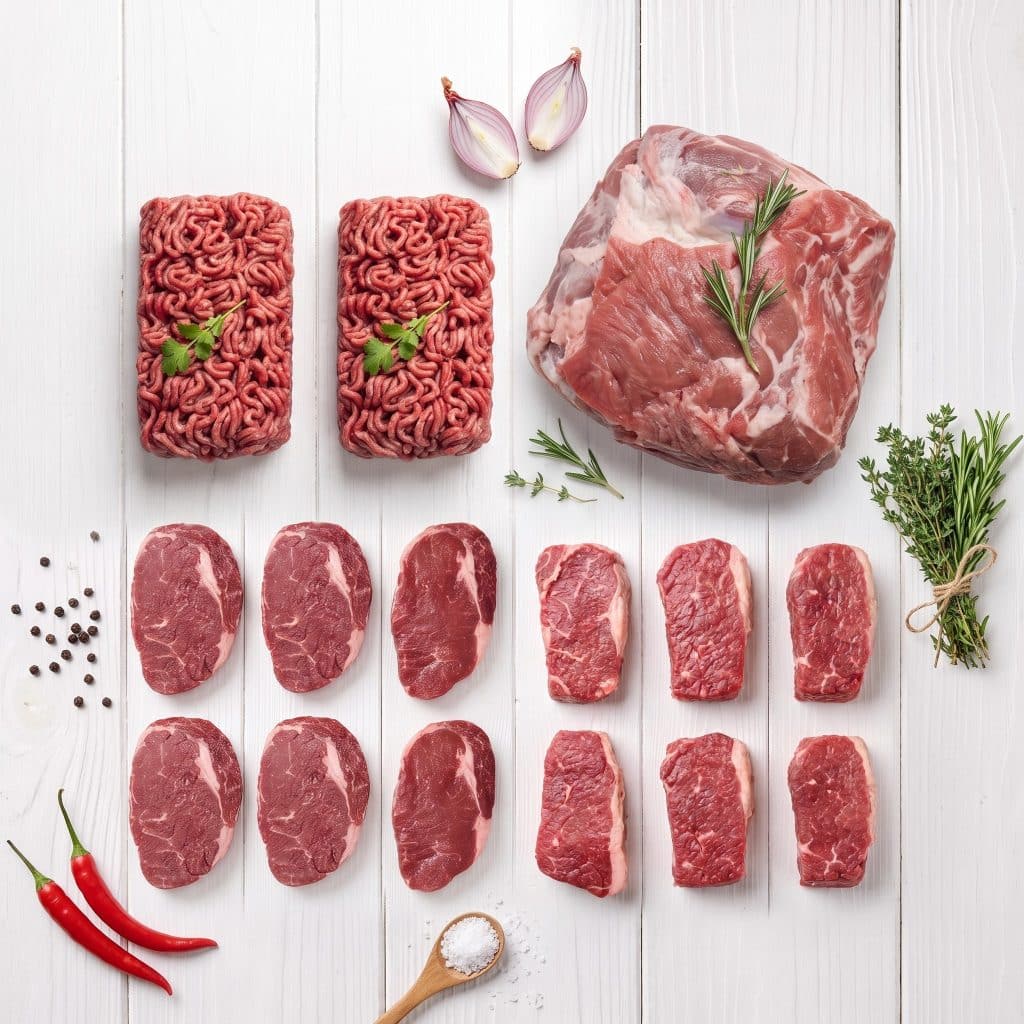

Australia's NFAS sets legally defined feedlot minimums by category — 35 days for the newest GFF standard, 60-70 days for GFYG, and 100+ days for GF — with 50-120 days as the general industry average (Australian Good Meat/MLA). The US grain-finishing norm runs considerably longer at roughly 4-6 months, or 120-190 days, with no equivalent national day-count standard (Beef Research).
That duration gap shows up in market-ready age too. US grain-finished cattle are typically ready for market at 14-22 months old, while grass-finished cattle take longer, at 20-26 months, since they're growing on pasture alone with no feedlot acceleration (Beef Research, 2020).
It's worth remembering that even a grain-finished US animal spends most of its life grazing. The feedlot stint is the final 4-6 months of a much longer story — around 82% of a grain-finished animal's total feed intake, by weight, still comes from grazing and forage before it ever reaches the feedlot (Beef Research, 2020). So is "grain fed" really the opposite of "grass fed"? Not quite — it's closer to grass-fed-plus-a-finishing-step.
[INTERNAL-LINK: "how MSA and USDA grading compare" → AU/USA grading cross-reference article (once published)]
Australia's 2025 beef exports split roughly 71% grass-fed to 29% grain-fed by volume — 1,096,456 tonnes of grass-fed beef against 449,292 tonnes of grain-fed, both record years (MLA, "Beef exports break new ground in 2025"). The US runs the opposite way: only around 4% of US retail and foodservice beef sales are grass-fed, worth roughly $4 billion, according to an SDSU Extension analysis last updated in 2021.
That doesn't mean Australia's grain-fed share is shrinking. 2022 saw a record 47% of Australian cattle processed go through a grain-finishing programme (MLA) — and in the 2025 export figures above, grain-fed volume actually grew faster year-on-year (+20%) than grass-fed (+13%), even though grass-fed still holds the larger overall share.
Worth flagging: that US ~4% figure comes from an SDSU Extension analysis last updated in June 2021, itself citing a 2017 industry report — not brand-new data, but still the most-cited figure available for US grass-fed market share. Within that dedicated grass-fed supply chain, US producers process around 230,000 head a year, under 1% of the roughly 30 million cattle processed each year nationally.
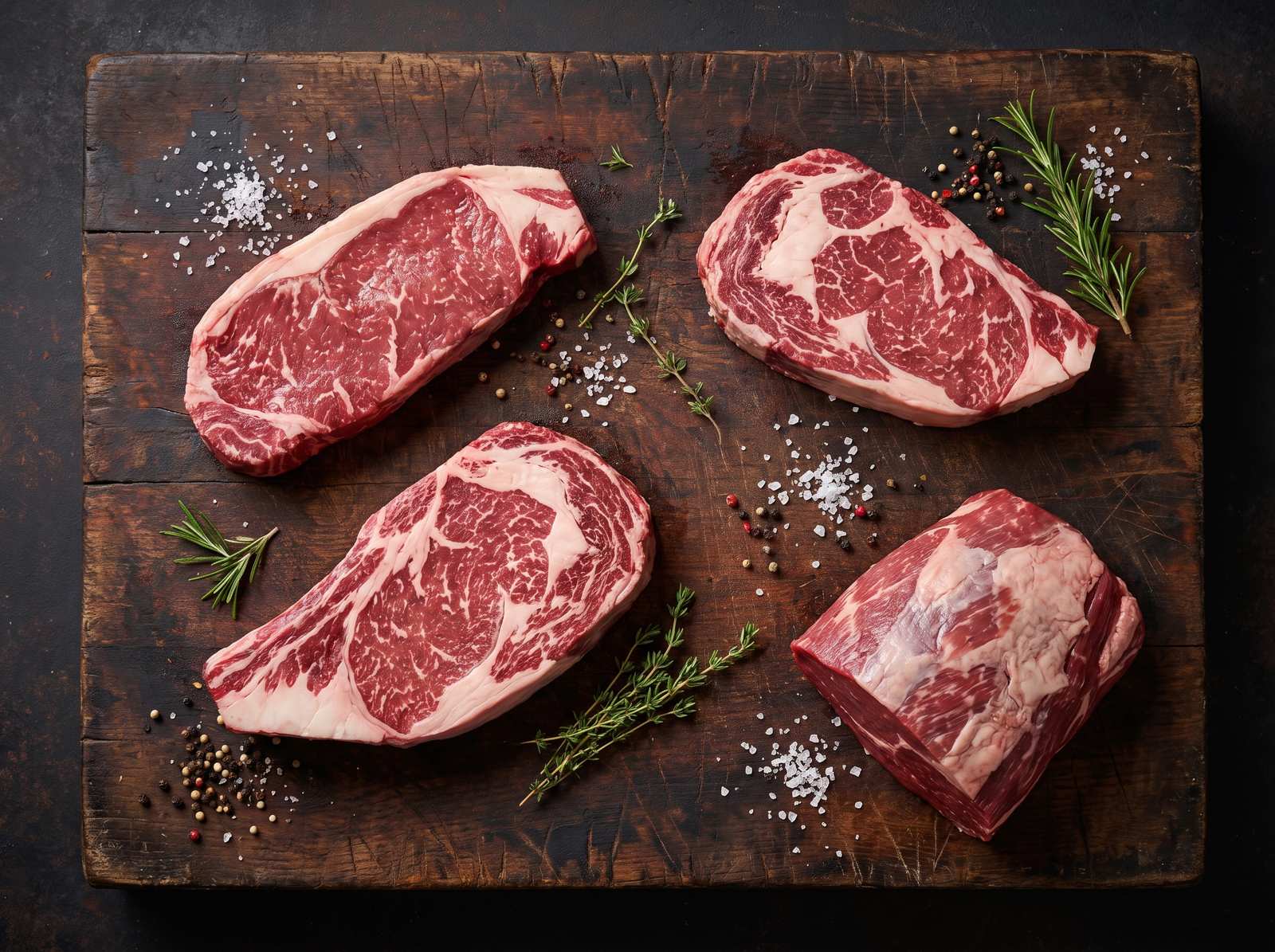
Does that make Australian beef simply "better"? Not necessarily — it just means the two markets are built around opposite defaults, and neither one is wrong for the climate and economics behind it.
[INTERNAL-LINK: "grass-fed vs grain-finished Angus" → angus-beef-australia (once published)]
Not quite. Australian grass-fed claims trace back to AUS-MEAT's audited NFAS and ARC Framework, while US grass-fed claims have been voluntary and self-certified since the USDA withdrew its standard in 2016 (USDA). Same words, different levels of independent verification behind them.
Not directly anymore. The USDA's Agricultural Marketing Service withdrew its formal "Grass (Forage) Fed" standard on January 12, 2016 (USDA). A 2019 FSIS guidance document offers a definition, but compliance is self-declared, with no mandatory audit behind it.
In practice, very little. Both describe cattle that ate only pasture, forage, or fodder for their entire lives. "Finished" sometimes emphasises the final growth stage specifically, but Australia's ARC Framework and most US usage treat the two terms as interchangeable.
Australian NFAS categories set 35, 60-70, or 100+ day minimums, averaging 50-120 days overall (MLA). US grain-finishing typically runs 120-190 days, roughly 4-6 months, with no equivalent national day-count standard (Beef Research).
Grass-fed beef carries a markedly lower omega-6 to omega-3 ratio, 2.14 versus grain-fed's 8.28, across 337 ribeye samples (Journal of Animal Science, 2026). Grain-fed beef typically offers more marbling and a richer flavour, so the healthier pick isn't always the richer-tasting one.
PCAS, the Pasturefed Cattle Assurance System, was Australia's audited grass-fed certification, requiring annual third-party checks on member properties. It ceased on January 1, 2026, with its standards folded into the broader ARC Framework (AUS-MEAT).
So, is your beef grass fed? By now it's clear that question doesn't have a one-word answer. It depends on the country, the diet timeline, and — increasingly — who's actually checking the claim behind the label.
Key takeaways:
- Australian cattle default to pasture, moving to grain for a short 50-120 day finish; US cattle default to grain for 4-6 months, with grass-fed as a smaller but fast-growing niche.
- The four terms — grass fed, grass finished, grain fed, grain finished — describe the same two systems, just at different life stages.
- Australia audits its claims through AUS-MEAT's NFAS and ARC Framework; the US has run on voluntary, self-certified grass-fed labels since the USDA withdrew its standard in 2016.
- Grass-fed beef's lower omega-6:omega-3 ratio (2.14 vs 8.28) is the clearest nutrition difference between the two systems.
If you want beef where the feeding programme and category are actually documented rather than assumed, browse Pryde Butchery's grass-fed and grain-fed beef range and ask us directly which standard your cut sits under.